
.png?h=595&iar=0&w=2781&hash=5FD5E69473BCC22199FBFA2FB71B6033)

Bright Colors, Blue Teeth, and Big Personality: The Harlequin Tuskfish
Author: Chris Sergeant
It’s hard to beat a coral reef for sheer bright, vivid colors. Replicating this rainbow-hued environment is often the reason marine aquarists get into the salty side of the hobby, taking inspiration from these bustling metropolises, practically bursting at the seams with vibrant marine life. And there are few more colorful fish choices to complete the reefkeeper’s palette than the harlequin tuskfish.
As far as fishes for a reef tank go, there are plenty of centerpiece contenders. The mandarin dragonet (Synchiropus splendidus) and candy basslet (Liopropoma carmabi) are well known to most reefkeepers, while the dragon moray (Enchelycore pardalis) is an aquarium trade rarity many would love to see show up on their local dealer’s stock list.
Not to be outdone, reef invertebrates are equally capable of putting on a dazzling display of color—literally, in the case of the flashing flesh of the disco clam (Ctenoides ales) or the pulsating performance of a color-changing cuttlefish. Stomatopods, in particular the club-wielding peacock mantis shrimp that practically glows with resplendent green and reds, deserve an honorable mention here as well.
For me, however, there is only one winner in any contest of reef-fish color: the flamboyant harlequin tuskfish (Choerodon fasciatus). Hailing from the wrasse family Labridae, it is one of about 30 species that fall under the genus Choerodon, although, from an aquarist’s perspective, it is the sole representative that features in the aquarium trade with any sort of regularity.
A Colorful Character
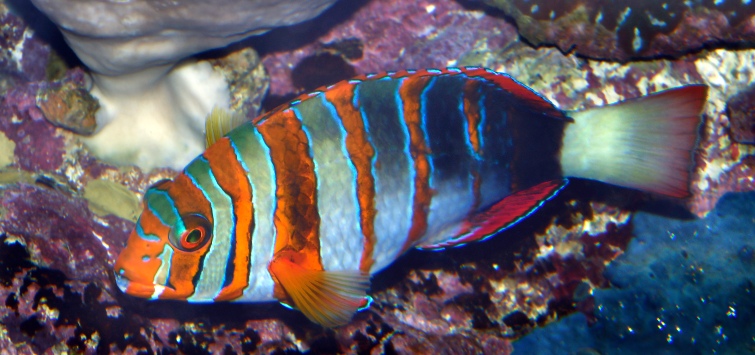
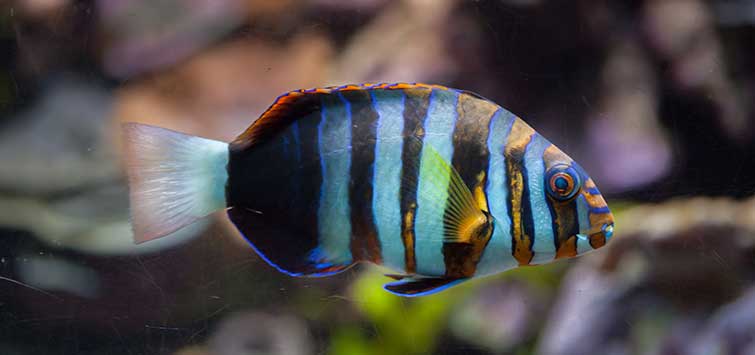
In terms of its common moniker, the harlequin reference couldn’t be more appropriate. Also colloquially known as Arlecchino, the harlequin is a comical servant character from early Italian theater, characterized by gaudy checked attire and physical agility, traits perfectly suited to almost all members of the Labridae family. As with the fictional character, it’s the tuskfish’s dazzling outfit that immediately draws attention, and its dress sense only improves with age. Adults tend to sport seven or eight pairs of bright, vertical copper-colored bands alternating over a white body, while those stripes are a toned-down shade of brown in juveniles, who also display large ocelli to the rear of both the dorsal and anal fins in their early development.
The final tuskfish accoutrements are dictated by the individual’s location. Generally speaking, the orangey bands of those collected in the waters around Australia have vibrant blue edges, while the red coloration of the ventral and anal fins is more intense, making them generally more desirable to aquarists. Those found around the Philippines often lack the blue banding highlights, reserving that adornment for just the base of the caudal fin instead.
The primary role of the character of the harlequin in early Italian theater was that of the trickster, incessantly attempting to thwart the will of his master in pursuit of his own interests. Substitute “master” with any diver attempting to photograph one of these fish as it diligently patrols its patch of reef and vigorously drives away intruders, and you get the picture.
Enjoying TFH Magazine? Subscribe Today!
Harlequin Tuskfish Diet (and Those Blue Teeth)
The way to the hearts of these underwater Arlecchinos is via their stomach. Spend any amount of time with one of these wrasses and you’ll see that they’ll devote the majority of it to actively scouring the reef, foraging for food.
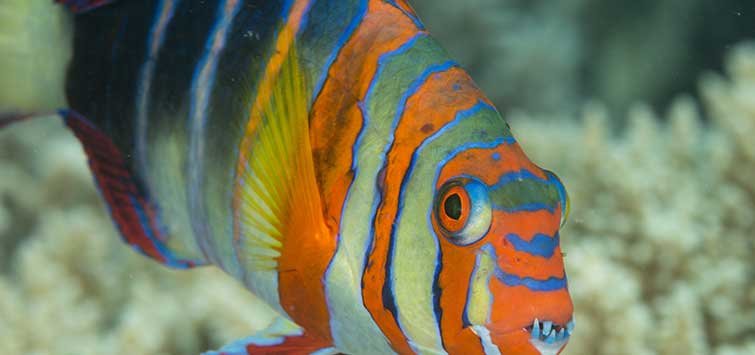
Their genus name of Choerodon is derived from Greek, with “choiros” referring to pig and “odous” denoting teeth. It is a clear reference to their prominent tusk-like anterior canines, which turn from a pearly white to powder blue as the fish matures.
This dentition isn’t just for show either. Prowling their seaward reef territories, these gourmands of crustacean flesh happily snack on a variety of motile invertebrates, making short work of even the most heavily armored prey items. Using their tusks to firmly grip their prey, they rip through to the fleshy interiors of crabs, clams, and sea urchins with a flick of the jaw, while snails are deshelled with equal ease.
Their canines are also handy for flipping over small rocks and rubble in search of hidden food, so larger individuals make handy and forceful aquascapers in their own right. There are even videos purportedly showing these tuskfish engaging in tool use as they grasp a bivalve in their jaws and smash it against a rock or coral head—nature’s own anvils—to break their way into the hard-shelled snack.
This tool use may be a case of mistaken identity, however, as their close cousin and star of BBC’s Planet Earth: Blue Planet II, the orange-spotted tuskfish (C. anchorago), is usually the ingenious fish in question. But it is worth noting that such tool-use behavior has also been documented in graphic tuskfish (C. graphicus) and blackspot tuskfish (C. schoenleinii), as well as in fellow Labridae members the yellowhead wrasse (Halichoeres garnoti) and the sixbar wrasse (Thalassoma hardwicke), so you never know.
While such fearsome fangs might evoke understandable trepidation when it comes to tank maintenance, these fish are only really a threat to smaller tank residents and are of little consequence to even the most careless of fingers.
A Sight for Superior Eyes
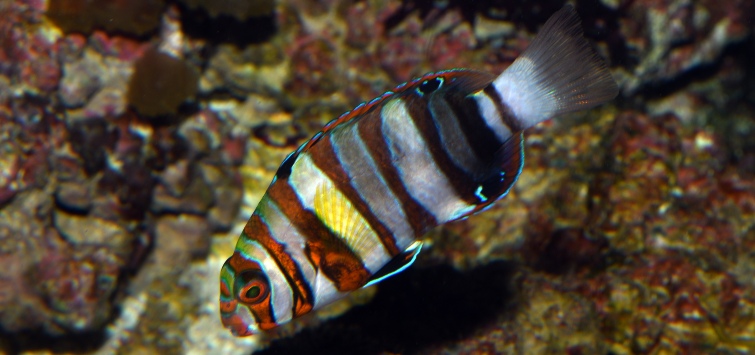
Equally as striking as those teeth are the harlequin tuskfish’s eyes. In keeping with the rest of its aesthetics, the enlarged ocular organs are a bright orange, but more impressive is the fact that the fish can move each one independently of the other, allowing an individual to map out their environment in the blink of an eye. As with all vertebrates, they possess certain retinal cells that enable them to process visual information and pass it on to the brain, but in the case of C. fasciatus and its cousin, the blue tuskfish (C. cyanodus), they have an alternative arrangement of those structures that allows them to focus in on and hunt small prey over the reef while simultaneously scanning the horizon for potential threats.
What fish are capable of seeing has long been a topic of interest, and members of the wrasse family, including C. fasciatus, have been well studied. The focus of much of this research has centered on the presence of light-sensitive proteins (opsins) that permit the absorption of light at particular wavelengths.
C. fasciatus possess specialized opsins that enable them to locate prey items moving against specific-colored backdrops—i.e., their reef feeding grounds—but they can also detect ultraviolet (UV) light, although the exact reasoning for this ability is as yet unclear.
In other reef dwellers, the ability to see UV light allows them to determine the specific facial patterns of conspecifics or to communicate with others in secret, away from the eyes of watching predators. The thought here, though, is that this capability might benefit individuals in their juvenile life stage by helping them to spot UV-reflecting zooplankton that make up the majority of their diet.
In the Aquarium
Having established what makes these harlequins so desirable, the next step is to determine how to keep them. When it comes to tank size, bigger is certainly better, given that adult specimens can exceed 12 inches (30 cm) in length and love to stretch their fins. These diurnal wrasses will spend a large part of the day prowling their territory, so be sure to incorporate plenty of rockwork in a way that doesn’t compromise on swimming space, and include a lot of caves and crevices for security.
It’s not uncommon for newly introduced individuals to take time to acclimate to their new surroundings. So a variety of refuges will be greatly appreciated, particularly in those first few days when your fish is finding its fins. The addition of corals and other sessile invertebrates is up to the discretion of the aquarist, although overall system volume will once again play a part.
Although it’s highly unlikely that your tuskfish will pick at corals and such, adults can be pretty messy, and the waste produced can contribute considerably to a tank’s bioload, impacting water quality and potentially coral health. Therefore, a fish-only-with-live-rock (FOWLR) system might be the way to go.
While many wrasses are known to take a subterranean nap after lights out, Choerodon species prefer a cave in which to sleep, but this doesn’t necessarily mean forgoing a sand bed, as the substrate helps encourage a micro-faunal buffet on which these fish can feed.
Mealtimes are a straightforward affair, but given their active lifestyle and high metabolism, “little and often” is best in terms of feeding frequency. Regarding the harlequin tuskfish’s diet, as with other larger wrasses, chopped meaty foods like fish, krill, or squid will be eagerly accepted, along with enriched brine shrimp, mysis, and prepared frozen carnivore diets.
It is less of concern as to whether a tuskfish will eat as it is to ensure that you are actually feeding it enough, as its natural propensity for consuming mobile reef critters does not diminish in a captive setting. Depending on how you view them, C. fasciatus can play a role in “pest” biocontrol, readily feeding on bristleworms and unwanted hitchhiking crabs, but they are nondiscriminatory, meaning supplementary predation is likely to be a problem, particularly if your cleanup crew relies heavily on shrimp, crabs, and snails.
As well as being avid invert enthusiasts, they will also see snack-sized fish as menu items, while, conversely, they are at risk of being bullied by more boisterous reef-dwellers. Because of this, careful consideration should be given before adding a harlequin tuskfish to an already established community reef. Ideal tankmates include angels, small triggers, tangs, and other wrasses, although always err on the side of caution, as fish are individuals, with members of the same species sometimes behaving and reacting in their own unique ways.
One definitively unsuitable tankmate, in a home aquarium context at least, is another harlequin tuskfish. In the wild, they typically occur in loose harems, but rather than aggregating in a tight-knit group, solitary adults are usually observed patrolling their own seaward patch of reef. Housing multiple individuals will likely only lead to a fight to determine who’s the fairest, and the fiercest, of them all.
This doesn’t mean that captive breeding is completely out of the question, as Wen-Ping Su and his marine aquaculture juggernaut, Bali Aquarich, proved in 2020 by successfully harvesting and raising eggs, but this was undertaken in vast 2,600-gallon (10,000-liter) multiple-species broodstock ponds with numerous individuals, rather than a living room reef tank.
The issue is that C. fasciatus are not sexually dimorphic, which means that distinguishing between sexes and pairing fish up isn’t possible. Like the majority of wrasse species, they are protogynous hermaphrodites that live in a harem consisting of several females and a single dominant male, along with a couple of transitional males, each waiting on the periphery to challenge for the top spot should the current incumbent be overthrown.
Perhaps the most important element of housing a harlequin tuskfish, though, is selecting the correct specimen to start with. These striking fish come with a suitably robust price tag, so you want to ensure that you get things right. Since they are wild-caught, the shipping process is always fraught with concerns, so it’s best to aim for individuals between 3 to 5 inches (7 to 12 cm) in length, as larger animals with insufficient body reserves struggle, as do smaller, more fragile fish.
These fish are naturally energetic and robust, with more of a rounded body than your typical wrasse, so any animals with sunken stomachs or that have been inactive for prolonged periods should be avoided. There’s no harm in asking to see a potential purchase feed, either, as any store worth its salt should be happy to demonstrate the health of their stock, and an acclimated tuskfish will always find room for an extra food morsel or two.
A True Standout
Amid a coral reef environment bursting with color and charisma, it takes something truly special to stand out from the crowd. The harlequin tuskfish, however, with its striking aesthetics and comical outlook, never fails to take its much deserved place at center stage—nature’s very own Arlecchino.