
.png?h=595&iar=0&w=2781&hash=5FD5E69473BCC22199FBFA2FB71B6033)
.jpg?h=350&iar=0&w=750&hash=6DFF499C441EA525036E3340755312DC)
Keeping Toby Puffers: Perfect for Small Marine Tanks
Marijke Puts
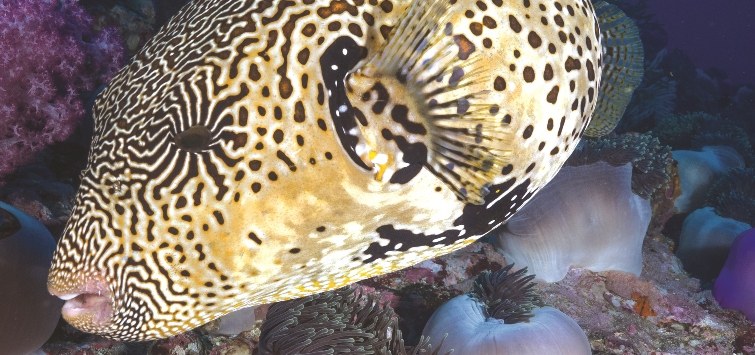
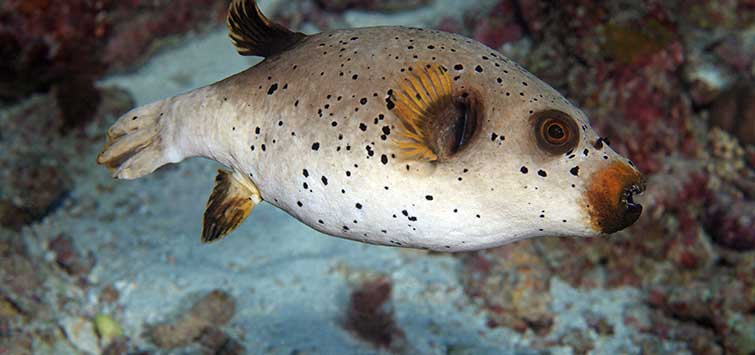
Even modestly sized members of the pufferfish family Tetraodontidae, such as the black-spotted Arothron nigropunctatus, reach massive sizes and require huge aquariums to keep. But there are smaller pufferfish with all the charming personality of their larger counterparts that can be kept in tanks as small as 30 gallons (about 110 liters)—a solidly nano tank in the saltwater hobby.
These mini puffers are gorgeously patterned and brightly colored. In fact, once you get to know them, the fact that their larger cousins get all the attention can seem downright unfair.
However, I also didn’t fall in love with Canthigaster, also known as the sharpnose or toby puffers, in the aquarium store. My enjoyment of them started in their territory. They’re common to see when snorkeling and diving in the tropics around much of the world. I once spent the better part of an hour following a completely unbothered Macaronesian sharpnose (Canthigaster capistrata) around the shallows of Madeira. My finned friend’s hovering swimming style, independently moving eyes, and curious nature set it apart from other fish that mostly seemed to live on aquatic autopilot.
As I mentioned in my recent feature on large puffers, when you gaze long upon a pufferfish, the pufferfish also gazes upon you. They seem to actually show an interest in the gangly ape that has entered their territory (or is staring at them through the glass), something you’d normally only expect from intelligent cephalopods like octopuses.
Enjoying TFH Magazine? Subscribe Today!
Despite their smaller stature, toby puffers are highly curious and uncannily aware, which is why they’re so perfect for aquarists who want to keep an actual pet rather than a mere decorative display fish.
Like their larger cousins, some of which are humongous by comparison, tobies can learn to recognize their owner, bursting into an adorably frantic wiggle dance whenever said person gets close to their tank. Sure, they do it in hopes of coaxing a tasty shrimp or clam out of their human friend, but still!
Whereas most pufferfish are googly-eyed murder machines, Canthigaster is more limited in its potential to cause mayhem, not just because of its size, but also because of the pointy “nose” from which the “sharpnose” name was derived. That little puckered mouth may be perfectly suited to picking invertebrates and algae off rocky structures, but it doesn’t work very well for taking bites out of swimming tankmates: These puffers don’t hunt fish. You can combine yours with all your regular reef favorites without the risk of a bloodbath.
.jpg)
Surprisingly Social
Although tobies are perfect puffers in miniature, sporting an almost identical basic body plan and exhibiting most of the typical pufferfish behaviors, they are also unique. For example, how many other marine pufferfish do you know that shoal with their own kind into adulthood? The answer: none. Although some form groups when they’re young, they go their own way once they pass the adolescent stage. In our aquariums, puffers are notorious for their total intolerance of their own kind, and we keep them alone to prevent mayhem and (probable) death.
Now, Canthigaster puffers don’t always occur in groups, and they’re frequently spotted browsing the reef on their own. However, when a male does get the chance, he’ll form a harem, surrounding himself with multiple females and staying in one area. He doesn’t call the shots in this polyamorous living situation, though: It’s the ladies who hold the territory, although their man is in charge of defending it. The fact that his lady friends stick to their established spots allows harems to form, but if they disappear, he’ll also abandon the premises.
Meanwhile, unlucky bachelor males that haven’t come across a welcoming group of sister wives to take them in are more nomadic in nature, although they do tend to lurk close to established harems. They’ll attempt to mate with the females in these groups when they manage to sneak close enough, although this tactic doesn’t usually yield results.
Instead, these solitary males mostly have to bide their time, setting up shop near harems and waiting for their current male to falter or die. Once this happens, they swoop in for a quick power grab. The females generally switch allegiances immediately and begin mating with the newcomer.
It’s a rare example of social drama in a family of fish that usually only briefly gets together to produce offspring! These complex social structures have been studied most extensively in the most common species in the aquarium hobby, the Valentini puffer, which we’ll meet shortly, but have also been seen in various other species, so they seem to apply widely across the genus—good for us aquarists to know.
The Canthigaster Rainbow
The genus Canthigaster currently contains 37 recognized species—quite a few puffers to choose from, all with the same base design but sporting different colors and patterns. Not all sharpnoses are regularly imported, but most aquarium stores will carry at least one or two. In some cases (and if you ask nicely), they can also order more obscure puffers for you on request.
Looking at online importers’ and retailers’ stock, you’ll usually see four sharpnoses available: the Valentini puffer (C. valentini), the blue-spotted puffer (C. solandri), the leopard sharpnose puffer (C. leoparda), and the Caribbean sharpnose puffer (C. rostrata).
The Canthigaster Mimics
Fascinatingly, toby puffers have doppelgängers. Although they’re actually filefishes of the family Monacanthidae, “false puffers” of the genus Paraluteres have evolved to mimic their distant Canthigaster cousins. Each species imitates a different puffer, and they’re seriously good at what they do!
The mimic and the original can sometimes be spotted shoaling together, which likely benefits the faux puffer through association with the real version’s toxicity, as they’re almost impossible to tell apart. Biologists refer to this as “Batesian mimicry”: protection from predation through imitation of an unpalatable species. You can occasionally find Paraluteres filefishes for sale in the more specialized aquarium stores. P. prionurus, which is a dead ringer for the Valentini puffer, seems to be the most common.
Tank Size
I’ve mentioned it already: Yes, these micro-puffers are suitable for micro aquariums, or at least much smaller setups than those required for full-size puffers. A 30-gallon (110-liter) tank can comfortably house a single individual, while 100 gallons (380 liters) or so should be enough to keep a harem of one male with two or three females. The latter isn’t very commonly done, but I bet it would be fascinating and allow you to see many more of your puffers’ natural behaviors and social interactions.
Like most pufferfish, sharpnoses spend much of their day browsing and foraging. They’re highly curious and do appear prone to boredom, which can result in a repetitive behavior known as “glass surfing.” As such, it’s a good idea to provide a rich environment full of live rock and other decor to help keep your fish busy.
The water quality in your sharpnose tank should be top-notch: Pufferfish are known to be particularly sensitive. Regular reef parameters work just fine, but you should give the aquarium time to mature before adding a sharpnose. Keep up with regular water changes and try to prevent fluctuations.
.jpg)
Diet
As its specialized pointy snout betrays, Canthigaster is not a fierce, crustacean-demolishing hunter like larger pufferfish. But that doesn’t mean it doesn’t have a taste for meaty foods. Inside its snout are those typical fused puffer teeth ideal for cracking hard carapaces, and it ain’t afraid to use ‘em. It’s easy to see how this handy combo—mouth perfect for probing, teeth perfect for crushing—makes small bugs feel suddenly unsafe.
However, despite their ability to expertly extract prey like polychaete worms, echinoderms, mollusks, tunicates, corals, and occasionally sponges from the rocks, no sharpnose puffer appears to be fully carnivorous. Their exact diet varies from species to species, but the usual aquarium suspects dine on red, green, and coralline algae in addition to the standard meaty fare.
If you’re familiar with pufferfish husbandry, you’ll know that their fused “beak” never stops growing. This allows them to feed on hard-shelled foods but also means their teeth can overgrow if such prey is lacking, rendering them unable to eat at all. Any aquarist who’s ever had to cut a puffer’s teeth manually knows this is a delicate and highly stressful situation for both fish and keeper.
Luckily for us, Canthigaster teeth aren’t nearly as prone to overgrowing as those of larger puffers, though it can technically still happen. A soft diet doesn’t work for these fish, so offer plenty of crunch, as well as live rock, for your puffer to graze on to help keep its chompers in good condition.
A varied diet consisting of frozen foods such as mysis and chopped squid mixed with crunchy items like whole small shrimp, pieces of crab leg, live or frozen snails, and cockles or clams on the half shell should work well. You can supplement with plant-based items like nori, macroalgae, and formulated foods for omnivores and herbivores for a complete diet.
Compatibility
As we’ve seen, sharpnoses are pretty mellow as far as puffers go. They don’t hunt large prey, making them safe to keep with all but the least assertive and most delicate (long-finned) tankmates. Most of our saltwater favorites, like clownfish, damsels, angels, basslets, cardinals, and many more, will do just fine with a Canthigaster for a neighbor.
Things are different when it comes to invertebrates, which are on all sharpnose puffers’ menus. Even in this category, though, total destruction is not guaranteed, which is exceptional for a pufferfish. This being said, I wouldn’t dare add any expensive inverts or corals to my Canthigaster tank. Some aquarists experience no trouble whatsoever, but plenty of others do report slow but steady decimation of their invert population, so the risk is, unfortunately, real.
All but the largest shrimp, like mature Lysmata cleaners, are at risk of predation. The same goes for crabs. Starfish may be nibbled on, too, and you can forget about snails and most conchs entirely—those are the sharpnose puffer equivalent of a walking buffet. Even if an invertebrate is too large to kill outright, the pufferfish is apt to nip at and harass it until it keels over from infection, starvation, or just plain stress.
And what about corals? Well, they are on the menu for some sharpnoses, but that doesn’t totally preclude the possibility of keeping a Canthigaster in a reef tank. If you don’t want to take any risks, a FOWLR setup is your best bet, but cheap and quick-growing corals do have a real shot at survival even with one of these puffers prowling the premises.
As a final note, like other pufferfish, Canthigaster puffers can avoid predation by ingesting large amounts of water to temporarily puff themselves up. It’s kind of overkill on their part, as they are also extremely toxic, after all. Regardless, be sure to never take your pufferfish out of the water, as it can die if it ingests air while trying to puff up because of the stress.
A Puffer You Can Keep!
When it comes to pufferfish, large species in the genus Arothron (plus the charming Diodon porcupinefish) tend to get all the love. But if you ask me, Canthigaster are the true winners! They bring beautiful colors and spectacular patterns to the aquarium, they’re reasonably reef-safe, and they’re generally friendly toward swimming tankmates. Add to that a virtually unmatched size-to-personality ratio, and I think you’ll agree with me that this might just be a perfect aquarium fish.