
.png?h=595&iar=0&w=2781&hash=5FD5E69473BCC22199FBFA2FB71B6033)

Pictus Catfish and Other Wonderful Pim Cats
Stewart Thacker
In the world of fishkeeping, catfish are among the most diverse and sought-after groups. While some species are peaceful, many more are large, predatory, or aggressive. Of those that are suitable community fish, many, such as the cory cats, just don’t have that “catfish look.” Rest assured, though, that there are plenty of smaller, friendly, and suitable catfishes for aquarists of all experience levels that do fit the look, including the family Pimelodidae, especially the genus Pimelodus, collectively known as pim cats.
Another common name used for pim cats is long-whiskered cats, a name derived from their notably extended whisker-like barbels, which are long in proportion to their bodies. Members of the family Pimelodidae are generally benthopelagic, meaning they spend much of their time near the bottom but also move freely into open water. Some species are active and social, while others are more sedentary or secretive—a range of behaviors we will explore below.
The family itself has undergone considerable taxonomic revision over the years, but currently includes roughly 100 recognized species. It also encompasses some of the aquarium world’s most impressive giants, such as the redtail catfish (Phractocephalus hemioliopterus) and the tiger shovelnose catfish (Pseudoplatystoma fasciatum).
Not every member of this family, nor even of the genus Pimelodus, is suitable for home aquaria, however. As a group, pimelodids tend to be somewhat territorial, though this varies by species. Here, we’ll focus on those that remain a manageable size, adapt well to community setups, and can be enjoyed by aquarists at nearly any experience level.
Aquarium Setup
All members of the family Pimelodidae originate from South America, where they inhabit warm, tropical river systems. Because of this, suitable aquarium conditions should generally reflect those environments. While there is natural variation across South American waterways, several key characteristics remain consistent enough to support a wide range of compatible community species, including multiple pimelodids in the same aquarium.
Aim for water temperatures between 73° to 82°F (23° to 28°C); in my experience, pim cats thrive particularly well at around 75° to 78°F (24° to 26°C). They adapt to slightly acidic through neutral water, so a pH of 6.0 to 7.5 and soft to moderately hard conditions are ideal.
Their native habitats are typically well oxygenated, so provide strong, efficient filtration and good surface agitation. Larger filters not only maintain oxygen levels but also manage the heavy bioload common to pimelodids and other catfishes. Keep ammonia and nitrate levels as low as possible.
For layout, keep vegetation sparse to moderate, positioned toward the back or center to leave open swimming space. Some species are more active and social, while others prefer hiding spots or driftwood structure.
Lighting should be subdued; these catfishes are most comfortable under dim or shaded conditions. Supplemental “dusky” lighting in yellow or blue tones can highlight their activity periods, while soft red light works well for nighttime viewing. (Green lighting should be avoided, as it can stress nocturnal fish.) Finally, remember that pim cats are scaleless, so take extra care when using medications, as they can be more sensitive than scaled fish.
Enjoying TFH Magazine? Subscribe Today!
Feeding them is usually straightforward, but it’s important to provide a balanced diet, especially for species that are more omnivorous. I’ve had good results by mixing several types of prepared foods—algae wafers, freeze-dried brine shrimp, sinking pellets, and other dry options—and alternating them at feeding time. The goal is to make sure each meal includes a variety of nutrients, textures, and feeding behaviors.
While a blended mix of pellets and wafers can help ensure a good baseline diet for most fish in the tank, remember that it doesn’t replace the nutritional value of quality frozen or fresh foods. The more carnivorous pim cats still need protein-rich fare such as bloodworms, mysis, or chopped shrimp to stay healthy and maintain natural feeding behavior.
When setting up an aquarium for pim cats, structure is the most important factor to consider. Plants, whether live or artificial, aren’t essential for the catfish themselves, but a modest amount of vegetation adds interest and benefits other tankmates. You don’t need to plant heavily, but include a few groupings for balance and visual appeal.
What pim cats truly appreciate is structure—caves, driftwood, roots, undercuts, and scattered hiding areas. These elements provide security and help reduce aggression, especially when several individuals are housed together. Arrange the layout creatively by varying substrate depth and using materials of different sizes, such as rocks, smooth gravel, and larger stones. The goal is to create natural nooks and crannies throughout the tank so that even territorial fish can claim their own space without constant conflict. Let’s have a look at some good pim-cat choices for your tank.
The Pictus Catfish
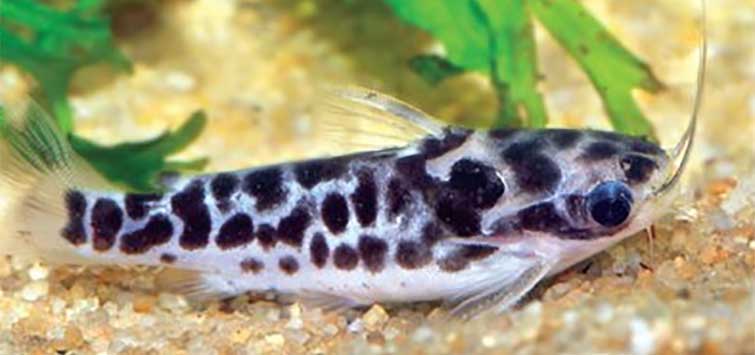
The “poster fish” for this family is the pictus catfish (Pimelodus pictus). A shimmering silver fish covered in dark polka dots, it’s one of the most recognizable and widely kept members of the group. The Pimelodus pictus combines the classic catfish look with a manageable size and peaceful temperament, making it a hobby favorite. Reaching about 4 inches (10 cm), they are energetic and constantly active, especially when kept in small groups. They spend much of their time in motion, patrolling every inch of the tank, which gives them a uniquely graceful appearance that’s as much about movement as color.A central cluster of plants or driftwood provides an excellent point for them to navigate around while still leaving open swimming space. As omnivores, they accept nearly all prepared and frozen foods, including pellets, frozen bloodworms, and algae wafers. A diet that balances meaty and plant-based foods keeps them healthy and active.
The pictus catish fits well with other midsized community species of similar or slightly larger size. Personally, I’ve kept them successfully with small Senegal bichirs (Polypterus senegalus) and active rainbowfish. Still, like any catfish, they will eat whatever fits in their mouth, so fry or very small tankmates, such as tiny tetras, are not suitable.
When feeding, pictus catfish are especially entertaining. They dash around the aquarium, circling decorations and tankmates in search of food and are lively and animated at mealtimes. Provide plenty of open areas for this behavior while still offering structure and cover.
Ideal tankmates include cory cats and active schooling fish, such as larger danios (e.g., Devario spp.), though many other species will work as long as size and temperament match. The pictus catfish is a wonderful introduction to the group: active, visible, personable, and undeniably beautiful.
The Horseface Cat
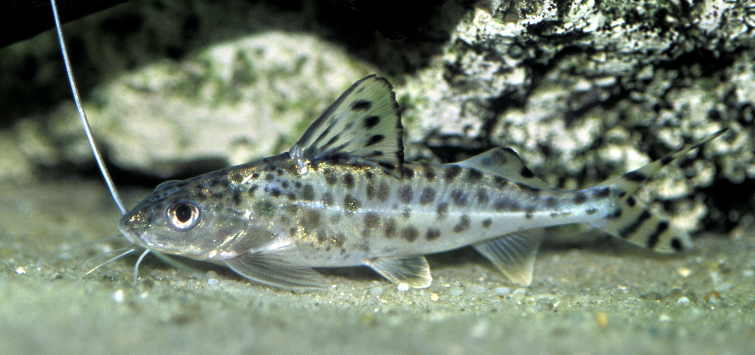
Another good option is the horseface cat, sometimes sold as the foxface cat (Goeldiella eques). Like the pictus catfish, it has a sleek, silvery body with irregular black mottling, but it grows larger—usually around 10 inches (25 cm)—and needs a correspondingly spacious aquarium. This species is more reserved than the pictus, emerging mainly after dark to feed, which makes it an excellent contrast in behavior for aquarists who enjoy observing their tanks at night.Horseface cats are most active under dim or red lighting, which allows natural nighttime behavior without causing stress. They are carnivorous and readily accept meaty frozen foods such as bloodworms, mysis, and chopped shrimp. They will eat anything small enough to fit in their mouth, so tankmates should be sturdy and of similar or larger size. I’ve often seen them emerge cautiously from their hiding spots, take a slow lap around the aquarium to feed, and then retreat again once satisfied—a pattern that gives them a distinct and endearing personality.
Good companions for the horseface cat include banded leporinus (Leporinus fasciatus), silver dollars (Metynnis argenteus), and driftwood cats (Auchenipterus nuchalis). Larger, peaceful fish that share similar water needs make the best choices overall.
Messy Pim Cat
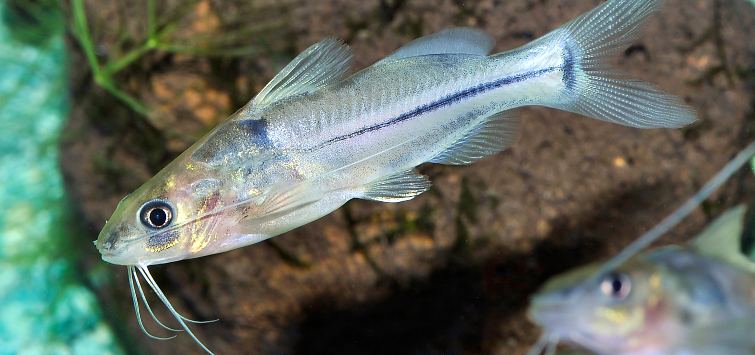
The next option is the messy pim cat (Brachyrhamdia meesi), seldom seen in the aquarium trade. Because it is so uncommon, detailed care information can be hard to find, but its general needs are similar to those of the Pimelodus pictus. It reaches about 2½ inches (6 cm), making it one of the smallest members of the group.Like the, it is active and sociable, spending much of its time swimming in the open rather than hiding. Keeping them in small groups helps them feel secure and display their natural behavior.
The messy pim cat is omnivorous and readily accepts most prepared and frozen foods, including small pellets and bloodworms. It coexists well with peaceful fish too large to be viewed as prey, though it may be vulnerable to larger tankmates. Good companions include cory cats, chocolate whiptail catfish (Rineloricaria lanceolata), and midsized schooling fish, such as larger tetras and peaceful barbs that reach at least 2 inches (5 cm) as adults.
Giant Bumblebee Pim Cat
Another uncommon and striking species is the giant bumblebee pim cat (Pseudopimelodus bufonius). Like the messy pim cat, it remains rare in the aquarium trade, and little formal information exists about its care. It grows to about 9½ inches (24 cm), so mature specimens need a generously sized aquarium.This species is more secretive than others, spending much of its time resting in shaded areas or beneath structure. Despite this reclusive nature, aquarists often note an unusual behavior: Bumblebee pim cats sometimes swim in tight circles against the glass, particularly during feeding. The cause isn’t well studied, but it adds a curious and memorable element to their behavior in captivity.
The giant bumblebee pim cat is a carnivore that thrives on meaty frozen foods such as bloodworms, shrimp, and similar fare. Because of its wide mouth and strong feeding response, tankmates should be sturdy fish that are at least half again as large as the catfish itself. Suitable companions include silver dollars (Metynnis argenteus and similar) and bigger, even-tempered South American cichlids, which share comparable temperature and water chemistry requirements, such as eartheaters (e.g., Geophagus or Satanoperca) or severums (Heros efasciatus or similar).
The Vulture Catfish
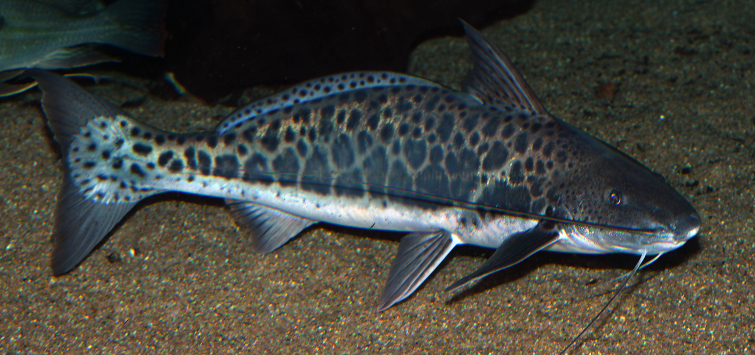
Next on our list is a larger and more infamous member of the group, the vulture catfish (Calophysus macropterus), also known in parts of South America as the piranambú. This powerful, streamlined predator can reach around 16 inches (40 cm) and requires a large aquarium with strong filtration and ample swimming space. It is not a social species and is best kept singly or with only the toughest possible tankmates.The vulture cat thrives in clean, fast-moving, well-oxygenated water that resembles the large river channels it inhabits in the wild. Directing the filter return to create a horizontal current helps replicate these conditions and encourages natural behavior. Include large driftwood, boulders, or sturdy caves for resting areas between feedings.
These fish are often sold as juveniles only 2 to 4 inches (5 to 10 cm) long, which makes them look harmless in a pet store tank. Unfortunately, that’s where many hobbyists get into trouble. Vulture cats grow fast, and the same fish that seemed peaceful at first quickly turns into a heavy-bodied predator. More than a few aquarists have watched their “friendly” vulture cat slowly pick off tankmates one by one until it’s the only fish left in the aquarium.
Feeding is straightforward but should focus on a varied high-protein diet. Offer meaty frozen or fresh foods such as shrimp, fish fillets, and bloodworms. Although this species will scavenge uneaten food and occasionally feed on carrion—hence, the name “vulture cat”—it should never be viewed as a cleaner fish. Once decomposition sets in, it usually ignores the food item entirely.
Because of its size and highly opportunistic nature, tankmates must be selected with extreme care. Only large, powerful fish that can handle its strength and predatory behavior should be considered. Suitable companions include adult peacock bass (Cichla spp.), silver or black arowanas (Osteoglossum spp.), and massive loricariids, such as Panaque or Acanthicus species. Even with such choices, aggression or injury remains possible, and many aquarists ultimately find that the vulture cat does best either alone or in a public-display–style setup with other large, armored river fish.
Some Pim Cat Parting Notes
There’s a fair amount of overlap in compatible tankmates among the species discussed here, but size differences should always be considered carefully. Any fish small enough to fit in a catfish’s mouth is at risk of becoming food, regardless of temperament. Likewise, avoid keeping pim cats with notorious fin-nippers—those long barbels and trailing fins can become tempting targets. Fortunately, most mid- to large-sized catfish quickly command respect in the aquarium, and few species will bother them once territories are established.
There’s a tremendous variety of catfishes available to aquarists, including many not covered here, that can make excellent additions to community aquariums when chosen with care. Each species brings its own combination of behavior, pattern, and personality, but all require thoughtful research to ensure the right environmental match and tankmates.
Catfish truly come in every shape and size imaginable, from playful, active midwater swimmers to impressive nocturnal predators. With a bit of planning, there’s almost certainly a pim cat that fits your aquarium perfectly—one that will keep you fascinated for years to come.