
.png?h=595&iar=0&w=2781&hash=5FD5E69473BCC22199FBFA2FB71B6033)

Opae Ula: The Hawaiian Volcano Shrimp
Joshua Wiegert
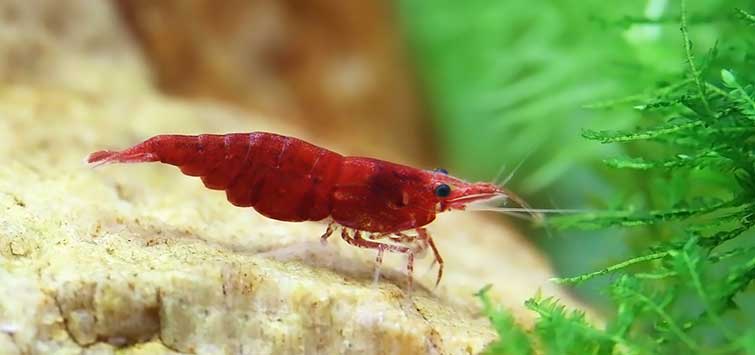
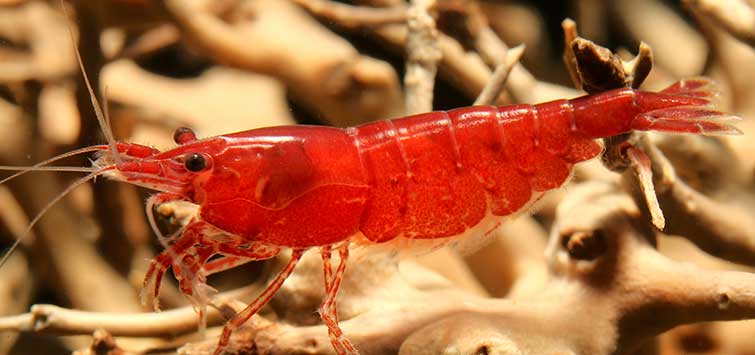
As part of our pico tank series, we set up several truly tiny tanks. The smallest of those, and probably most exciting, housed a strange little shrimp known as the opae ula. This diminutive creature was kept in the smallest of our pico tanks, a standard restaurant-size water glass.
But after the experiment was done and the photos taken, I figured these interesting little inverts—often known in the hobby as volcano shrimp—deserved a proper setup more conducive to watching them live their best little lives. Let’s have a look at these amazing little shrimp in more detail, as well as some more appropriate tanks for them.
Getting a Little Salty: Brackish-Water Setups
First, let’s get this out of the way: opae ula are brackish-water shrimp. They cannot survive in pure freshwater conditions. They can handle straight marine water, and will even reproduce in it, albeit a bit slowly, but their natural habitat and preference is for a salinity somewhere in the middle.
In nature, they live in what are called anchialine pools, a Greek term that roughly translates to “almost-sea.” These small pools are often connected to the ocean by subterranean passages, and their salinity can vary greatly with depth, season, rainfall, location, and other conditions.
When discussing salt levels in an aquarium aquarists use relative density, or specific gravity, meaning the density of a material relative to pure water. Pure water would have a relative density of 1.000; add a bit of salt to it, and the density increases. Somewhere around 1.025, it reaches the average relative density of ocean water.
You’ll find these volcano shrimp mostly in areas where the salinity runs about 1.010 to 1.016, or roughly about one-third to two-thirds strength saltwater. I run mine at the lower end of the range, mostly because I tend to be scatterbrained and might forget to top off the tank for a while. It gives me a better margin of error.
Water evaporates, and salt doesn’t, so if you let the tank drop a bit, all the salt that was in the water gets left behind. The salinity has increased. If you top it off with brackish water, you’re just adding more salt. Over time, the salinity will increase, and increase, and increase.
For this reason, topping off the aquarium to make up for evaporation should be done with plain old freshwater. But do your water changes with brackish water, in the same salinity ballpark as your tank water.
Note that while we talk about salt, we’re not talking about salt. The stuff we use in a brackish aquarium is marine salt, which is different from the stuff you put on your French fries, or even the stuff labeled “aquarium salt” in the pet store. It contains not just sodium chloride, but all sorts of other salts and compounds that are vital for shrimp.
Smaller packages of marine salt are best for pico tanks, don’t buy in bulk here. If exposed to moisture or humidity, that big bag of salt can start to clump or turn into a brick, rendering it unusable. While economies of scale say bigger bags are better, for pico tanks it may make sense to buy the smaller ones. And a final note on salt: Never, ever, add undissolved salt to an aquarium with animals. Stir it and dissolve it completely, and let it settle for 24 hours before adding.
Enjoying TFH Magazine? Subscribe Today!
Enough About Salt—Let’s Talk Shrimp!
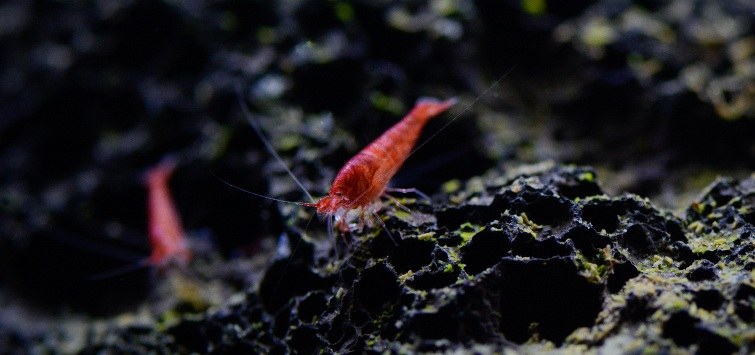
My first encounter with the cool little shrimp came when I saw a sealed glass sphere in a gift shop. These tiny “aquariums” were quite popular in the 1980s and even into the 2000s. The legendary Carl Sagan even received one as a gift and wrote about it.
They might live an impressive amount of time in this cramped novelty setup, but they can live decades otherwise. In freeing them from these gift-shop death globes, keeping opae ula slowly spread into a niche hobby. “Opae ula,” by the way, approximates the Hawaiian word ōpaeʻula, which means “red shrimp.” They haven’t caught on the way Neocaridina and other freshwater shrimp have, though. It’s probably the odd brackish-water habitat scaring people away, despite how cool “volcano shrimp” sounds.
But recently, a friend of mine mentioned he had some of these little fellows, and I managed to negotiate a group for myself. I thought they’d look cool in the water goblet—and they did indeed—but I knew they’d eventually need to be removed from there, especially as they started breeding.
The Hawaiian Volcano Shrimp Tanks
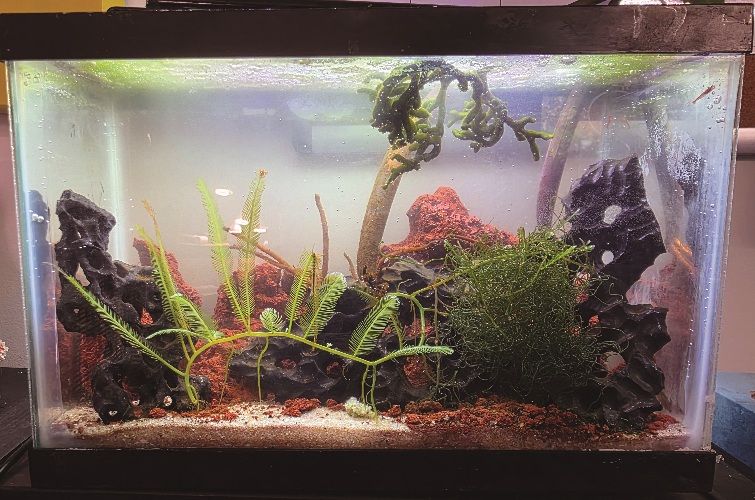
I decided to create two new tanks for these guys, both about 2½ gallons (almost 10 liters). One would become the “mother colony,” and the second would be used for culls as I set about fixing their famous red color trait through selective breeding, as they had lost much of their color as a result of poor breeding by their previous keeper.
The main display was set up to roughly mimic their natural habitat. I used a simple layer of pool filter sand on the bottom and a cobbled-together mixture of lava stone and something called “black hole stone” for décor. The black hole stone is interesting, with a neat cavernous pattern, and it feels almost ceramic.
The second tank was set up similarly, with a slightly deeper substrate. Into this, I placed a couple of “alpha shrimp.” These are not the same species of shrimp, and not even related; known scientifically as Metabetaeus lohena, they are members of the pistol shrimp clade, in the family Alpheidae (hence, the name “alpha”).
Pistol, or snapping, shrimp are a large group whose members have one gigantic claw. They use this claw to produce loud pops for communication, deter predators, and stun prey items. They live sympatrically throughout the entire range of the opae ula, and are a major predator of them. As it turns out, alpha shrimp are lazy predators, and I don’t think the population of opae ula ever decreased.
I did that thing I say never to do: I got the alpha shrimp without knowing much about them. Knowing they’re pistol shrimp, I set their tank up with a deep substrate so they could excavate burrows like pistol shrimp do. I discovered that alpha shrimp don’t do this. They act just like the regular opae ula, and, in fact, I can’t tell the two apart at a glance.
Alphas are bigger and have a weird claw, but they don’t really seem any different. Apparently, they’re much more difficult to breed, and I’m not sure anyone has successfully done so with them in captivity. Otherwise, they’re just bigger opae ula, with the alphas reaching maybe an inch (2.5 cm), and the opae ula, about half that, generously for both.
To set up a small tank for opae, all you need is a small container of some sort. My colony is in a one that’s on the larger side: you can use mason jars, or even old-fashioned fish bowls. I’ve even seen colonies running in the tiny “betta bowls” that should never, ever house a betta (or any other fish), and one absolute lunatic (me) once kept them in a water glass.
Almost any substrate can be used on the bottom, though some people even keep them in bare-bottom tanks. Decorations should be porous and something the shrimp can cling to, but if you want to use skulls and sunken pirate ships over lava rock, the shrimp don’t mind.
The tank doesn’t need a heater—as long as you’re comfortable in the room the tank is in, the shrimp will be, too. Filters are also unnecessary, and may even be detrimental, as they can remove food and catch smaller shrimp. It’s a huge mental block for me not to put a sponge filter in a tank, but I did it.
Live plants are a near impossibility for this tank. The salinity is too high for even most brackish-tolerant freshwater plants. They’ll make it a little while, but they’re not going to survive long-term. Mangrove props are certainly an option, and while they’ll work just fine at the prop stage, they’re eventually going to develop into trees. You can only bonsai a mangrove so much, and at some point it’s not going to work in a mason-jar-sized setup.
There are certain types of Chaetomorpha algae that are traded by brackish tank aficionados. This is a type of organized algae that is functionally identical to Java moss, so, of course, I hate it. Some aquarists report success with other types of marine macroalgae, including species of Caulerpa and Gracilaria, but your mileage may vary. Unless acquired from a brackish source, they will almost certainly need to be slowly acclimated to a lower salinity.
Lastly, though this might get me hate mail, the various reef aquarium pest algae that make up the “hair algae” groups, especially Bryopsis, are all actually types that thrive in brackish water. I find hair algae to be beautiful. I don’t want it in my reef tank, mind you, but a small tank full of bright-red shrimp picking their way through a dense field of hair algae? That sounds gorgeous.
Feeding and Nutrition
The topic of feeding is a point of contention in volcano shrimp fandom. For the most part, they can survive off the algae growing in your tank, and water changes will help to replenish nutrients. A wildly dense colony may need some additional feeding, but this is on the order of a morsel tossed into the tank once a month.
Since they are mostly maintained without filtration, excess food can be hard on the colony. Add a quality shrimp food once a month or so, just make sure not to overdo it—a little goes a long way, and overfeeding can quickly lead to problems.
Reproduction
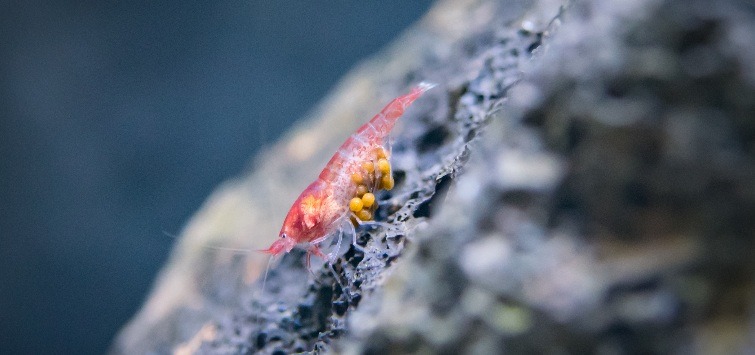
Keep in mind that opae ula do not reproduce like cherry shrimp. You’ll frequently see them running about with eggs under their tails, but these eggs don’t seem to hatch out at the same rate as those of their freshwater cousins, nor do they lay them as regularly as cherry shrimp. While it’s easy to turn six cherry shrimp into 6,000, your colony of opae ula is going to grow much more slowly. Give it time to develop and grow, and keep in mind that as it grows, it will begin to do so more quickly.
Tankmates for Opae Ula
The setup for the alpha shrimp is almost identical, so they make good tankmates, but I thought they’d be better at controlling the Hawaiian volcano shrimp’s numbers. The growing colony of their opae “prey” do provide their food, but the alphas also don’t each much. I purchased them with the idea that they’d be a control for the opae population, but they just don’t prey on them significantly.
So I give them a small amount of pellets, like one pellet per shrimp, once a week or so. They come out and eat it, but they don’t seem crazed for it. About the only time the alphas got excited was when I had a little extra live brine shrimp and tossed it into the tank, but too much brine shrimp in such a small water volume can be problematic, so they shouldn’t get used to it.
For us fish nerds, there’s a huge temptation to want to add something else to the tank. There are certainly a lot of small brackish-water fish out there that could go in with them. However, any species is likely to eat the opae, as well as produce ammonia, require feeding, etc. It’s best to leave them out. The only truly appropriate tankmates are some small snails.
Malaysian trumpet snails are often employed in the opae tank as cleaners. In brackish water, they’re not nearly the prolific breeders they are in freshwater, so they don’t seem to overpopulate the tank to the same extent. However, the idea of purposefully putting them in a small tank makes me twitch. Instead, many of our nerite snails can thrive with opae, and, in theory, they may even be able to breed successfully.
Keep in mind that nerite snails lay hard, sesame-seed packets of eggs on everything they possibly can, including the glass, and these egg packets are hard to remove. Personally, I find the tradeoff of algae for tiny white “rocks” all over the glass to not be worth it and have mostly stopped using nerites in my tanks.
Colorful, Hardy, and Fun to Watch
The Hawaiian volcano shrimp is a remarkably hardy animal, requiring minimal care and minimal space. They’re beautiful, brightly colored, and a lot of fun to watch. They’re an ideal choice for a small, pico-style aquarium, and a tiny tank with either the real volcano shrimp or their spiritual cousin, the alpha shrimp, can easily be tucked onto a desk, even in your office. While the brackish-water aspects present unique challenges, these shrimp are forgiving of mistakes in that area, and may even thrive with fluctuations in salinity and other parameters.
They can definitely be a challenge to find, though a brisk online trade in these shrimp exists. While perhaps not as easy as a trip to your local fish store, they’re worth the little extra bit of effort to find some.