
.png?h=595&iar=0&w=2781&hash=5FD5E69473BCC22199FBFA2FB71B6033)

Caring for Clown Loaches: Magnificent, Misunderstood Fish
Author: Andrej Jakubík
If I had to describe the clown loach in one word, it would be “misunderstood.” They are widely available in retail stores and common aquarium residents, but, from a biological standpoint, we hardly understand these fish at all. Most don’t perish because they are delicate, but rather because they are exposed to incorrect conditions from day one.
Much of what is said about caring for clown loaches largely consists of myths and half-truths, if not outright lies. The clown loach is an extremely intelligent, long-lived, and migratory fish whose needs are incompatible with the ordinary aquariums into which people place them without hesitation. They may be one of the least understood fish species in modern fishkeeping.
Separate Forms, Shared Biology
The clown loach (Chromobotia macracanthus) does not exist in just one homogeneous population in nature. There are at least two long-term geographically separated forms. One is tied to the island of Sumatra, and the other to Borneo.
The Sumatran form tends to be more robust, with a higher body and a slightly shorter head. Its black bands are often wider and less sharply defined, and individuals usually grow faster and reach largerdimensions. Group behavior and audible communication are more pronounced.
The Bornean form is more slender, with a more elongated body and longer head. The contrast between the orange and black is sharper, its growth is slower and more even, and the maximum size is generally slightly smaller. Their behavior in a group is calmer than that of their Sumatran cousins.
These forms are not officially described as subspecies. Genetic differences are marginally studied, and farm breeding mixes the populations, making origin impossible to determine. For the aquarist, the difference is of no fundamental importance, as requirements for space and water quality are the same.
It has a beautiful torpedo-shaped body that is yellow in bright contrast with black stripes. It grows up to 16 inches (40 cm), and the highest recorded weight is 1.03 lbs. (469 g). The ideal temperature is 77° to 86°F (25° to 30°C), ideally averaging 79° to 81°F (26° to 27°C).
One of its most interesting features is a spine in the form of an extendable structure located under the eye, the subocular spine. The fish can activate it during stress or when threatened. Its primary function is defense against being swallowed by a predator. I had the opportunity to try its effectiveness on my own hand when I inexpertly picked one up tangled in a net. I received an immediate and painful hit that took several days to heal.
The clown loach has a reduced gas bladder, an adaptation to life at the bottom of rivers with varying currents. It also possesses the Weberian apparatus, a system of auditory ossicles connected to the gas bladder that is extremely sensitive to low-frequency vibrations. This explains their extreme reactions to sudden changes in pressure, noise, or vibrations. Their perception of sound is hypersensitive, an evolutionary advantage in murky rivers.
Their pigmentation is also interesting; the black stripes are related to the local concentration of melanophores and hormonal activity, with contrast changing depending on social status. The clown loach has significantly developed taste receptors on the barbels and lower head, allowing for precise identification of food even in complete darkness, which is why it suffers on a substrate with sharp corners.
Enjoying TFH Magazine? Subscribe Today!
Clown Loach Tank: Bigger Is Better
The clown loach has fundamentally different space requirements during its life, and its underestimation is the most common breeding error. For juveniles at 1½ to 3 inches (4 to 8 cm), a clown loach tank of 40 to 50 gallons (150 to 200 liters) is possible but exclusively in a group of at least five or six fish, a fine sand bottom, hiding places, and very stable water quality.
Subadults at 5 to 8 inches (12 to 20 cm) require a tank of at least 100 to 150 gallons (400 to 600 liters), ideally with a wall length over 5 feet (150 cm), providing space for a social hierarchy and natural behavior. Cramped space leads to stress, aggression, and health problems.
Adults over 10 inches (25 cm) belong exclusively to very large aquariums of at least 265 gallons (1,000 liters) with a wall length of over 8 feet (250 cm), strong flow, and massive biological filtration. These are strong, mobile fish with high waste production. Anyone who can’t provide a large tank in adulthood should not get a clown loach at all.
As bottom-dwellers, the substrate in their tank is important. Use sand or fine, rounded gravel. Never use gravel with sharp edges, as the fish will lose their tactile barbels, a defect that can be lifelong and lead to food refusal or secondary infection.
Live plants, such as Java fern or crypts, are only possible with young individuals. Adults should be kept in tanks without plants or with resistant species like Anubias. The hardscape is fundamental and should consist of massive natural roots and smooth driftwood to create stable hiding places and shaded zones.
Large, smooth river stones are also suitable. Avoid sharp slates, lava stones, or any porous rocks that can cause skin trauma. Do not overfill the tank with structure, however; combine solid hiding places with open zones for swimming. Safety and functionality always take precedence over visual effects.
Several details are essential when caring for clown loaches, starting with their introduction to the aquarium. After bringing the fish home and equalizing temperatures, turn off the tank light for several hours before releasing them. Light is considered stress, and darkness allows them to explore their new home.
Soft, slightly acidic water with a gentle amber tint, similar to “black water,” is ideal. This can be achieved using Indian almond leaves, which leach humic acids and tannins. The aquarium must be established for at least two months before introducing the loaches.
The clown loach tank needs a tight-fitting lid, as these fish are excellent jumpers. Never pick up a net containing one with your bare hand. If tangled, submerge the net and fish back into the aquarium; it will calm down and extricate itself. During transport, use bags with a double bottom, as they can puncture a single layer with their spines.
Stress and Health Effects
Susceptibility to ich (white spot disease) is a direct consequence of stress. The fish has no scales, giving the parasite an advantage. Stress changes the composition of the protective body slime, making clown loaches permeable to the parasite.
Every significant stimulus triggers a hormonal reaction involving cortisol that destroys the protective barriers with long-term exposure. The clown loach has very fine skin and a strong dependence on quality surface slime.
Social stress is often underestimated; this is a strongly social fish, and being kept alone, in too small a group, or in a cramped space causes chronic stress. It is no coincidence that ich often appears after a move, adding new individuals, or changing the tank layout.
Rapid environmental changes, like a sudden temperature drop or an increase in nitrates, open the door to illness. The parasite can wait in low activity and break out when the fish’s immunity weakens. In fact, the clown loach is often the first to fall ill in an aquarium—not because it is weak, but because it does not hide its stress.
When treating, all loaches tolerate aggressive chemical preparations poorly, so compromises like half-doses are necessary. Broad-spectrum preparations containing copper and malachite green should be avoided with these sensitive fish.
Be aware though, that the entire group of loach fish has one common feature: they can rest lying on their side, looking dramatically dead. From their point of view, this is a completely normal activity, but it can give beginner keepers quite a scare. This position allows for maximum muscle relaxation and rest. It occurs more often in a group, a sign that the fish feels safe. If it were under stress, you would not see this behavior.
Sexual Maturity and Reproduction
In males, spawning tubercles can appear. These are small, firm growths, not of parasitic origin, typically seen on the head and along the back. Their occurrence signals sexual maturity, not approaching spawning. They are very rare in aquariums because most fish do not reach full sexual maturity. The tubercles suggest long-term stable conditions and low chronic stress. They are not a reason for treatment and disappear spontaneously after the hormonally active period.
Mixing different breeding stocks is sometimes considered dangerous. There is no evidence that mixing the Sumatran and Bornean forms causes genetic malformations or infertility. The real risk is pathogenic compatibility, not genetics. Every breeding stock carries its own spectrum of bacteria, protozoa, and parasites to which the fish are adapted. A clown loach from another stock can be unprepared for these microorganisms, leading to delayed problems like chronic weight loss, internal bacterial infections, or sudden deaths, which often affect dominant individuals.
Adding new individuals to an established group also disrupts the strong social structure and hierarchy, causing a long period of conflicts and stress that can lead to immune failure. Therefore, while not genetically dangerous, mixing stocks can be considered risky due to disease, stress, and social destabilization.
The clown loach has extremely slow sexual maturation, often only after 10 to 15 years in nature, making excessive harvesting biologically unsustainable. Reproduction does not occur in common aquarium conditions. Most individuals on the market come from farm breeding with hormonally induced spawning. In nature, they migrate during the rainy season to flooded areas, where changes in water level and chemistry trigger reproduction. These environmental impulses cannot be mimicked in an ordinary aquarium.
Their commercial breeding is dependent on the injection of gonadotropic hormones. Despite decades of breeding, there is no stably repeatable model of natural spawning in a home aquarium. Claims of “home breeding” have often turned out to be false, with purchased juveniles presented as home-spawned or confusion with other similar species. In the professional community, only farm breeding with hormonal induction is considered credible.
Feeding and Nutrition
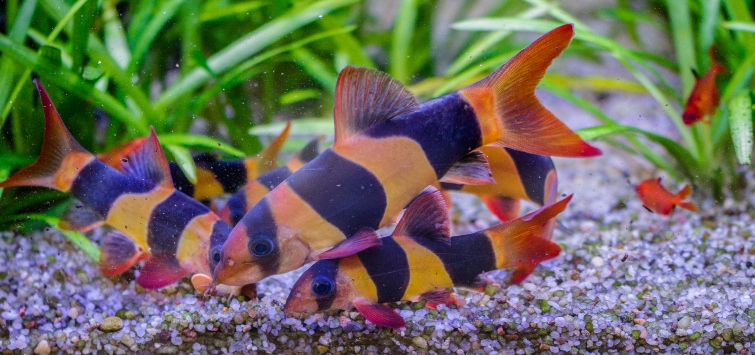
Although the clown loach is tied to the bottom of the tank, it cannot be called a “cleaner.” These are active omnivores with a predatory inclination. In nature, they consume insect larvae, crustaceans, mollusks, and detritus. In the aquarium, frozen mosquito larvae, bloodworms, shrimp pieces, and fish fillets are successful.
They willingly accept snails, crushing their shells with strong jaws, making them effective snail regulators. A plant component like cucumber or zucchini can also be served. An important part of nutrition is minerals, including iron. A deficit can cause weakness and deformities.
Smaller individuals accept sinking tablets, but the animal component should form a substantial part of their diet. They have a fast metabolism and require a higher proportion of proteins than common community fish. A lack of animal protein manifests in weight and color loss, and reduced activity. Feed them in the evening with dim lighting.
The structure of food is also important; fine larvae promote natural digging, while harder items like snails stimulate mechanical wear of the pharyngeal teeth. Long-term feeding of exclusively soft food can lead to their overgrowth. Combine frozen, live, and high-quality dry food, and alternate protein sources.
The frequency of feeding should be adapted to age and size; young fish benefit from smaller, more frequent portions, while adults can be fed once a day with a substantial meal. Overfeeding is a common problem.
Conservation in the Wild
In the 1990s, Indonesia realized that massive harvesting of clown loaches threatened local populations. Adult fish represent the biological core of the population because they are sexually mature and participate in reproduction. Their capture has a much greater impact than capturing young fish.
Regional regulations were introduced, prohibiting the fishing of large individuals and imposing seasonal restrictions during migration and reproduction. The goal is to not interfere with the “reproductive core” of the population. The removal of adult individuals disrupts migration cycles, reduces genetic diversity, and threatens the species’ reproductive potential. The protection of large individuals is one of the few rational tools to keep them alive despite the pressure of the aquarium market.
Don’t Let Them Be Misunderstood
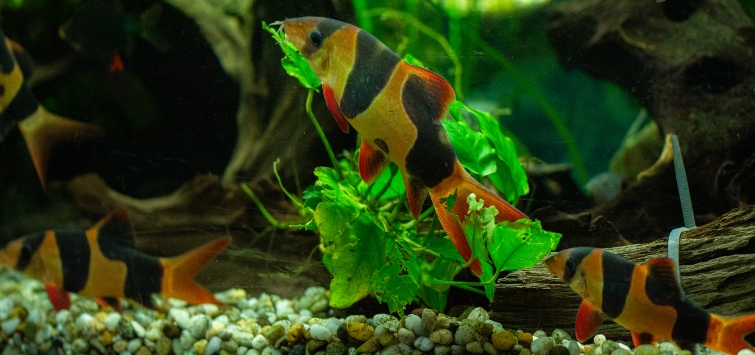
One of the great ironies of the clown loach is that its problems in aquariums rarely stem from fragility. Rather, they arise from the gap between what the fish truly is and what aquarists assume it to be. C. macracanthus is not a small decorative bottom fish but a long-lived, migratory species with complex social behavior and substantial spatial needs, traits that are easy to overlook when the fish is encountered as a juvenile in a store tank.
When those realities are ignored, the result is predictable frustration for both fish and keeper. When they are respected, however, the clown loach becomes something very different: a remarkably engaging aquarium resident whose intelligence, social interactions, and longevity reward the aquarist willing to provide the conditions it truly requires.