
.png?h=595&iar=0&w=2781&hash=5FD5E69473BCC22199FBFA2FB71B6033)

Exploring Fish in Chapada Diamantina: Brazil’s Diamond Plateau
Mark Chen
Brazil is a magical country that holds a great deal of enigmatic allure for fishkeepers. With its vast dominance of the Amazonia biome, it is the country that first comes to mind when thinking about the Amazon and its treasure trove of South American fishes.
Since my last expedition to the Rio Negro, I’ve been constantly thinking about going back to Brazil for further exploration. There were still two places in Brazil high on my bucket list before I could even think about exploring other countries: the Pantanal wetlands and the Rio Xingu. By chance or by fate, however, I got connected with Juliana Leroy, who would become my expedition guide to an unexpected gem that wasn’t only missing from my list, but one I have never even heard about: Chapada Diamantina, which translates to “diamond plateau” or “diamond highland.”
I have an absolute trust in Juliana’s knowledge and experience based on the video footage she has captured in the waters of Brazil. From her viral-worthy videos of oscar cichlids rearing fry and gorgeous schools of angelfish swimming between tree branches, Juliana has snorkeled and documented the clear waters in much of the country.
We connected on Instagram shortly after my Rio Negro expedition in 2024 and started to talk about my next Brazil trip right away. Initially, our intended destination was Rio Tapajos, a major tributary of the Amazon River. However, due to logistical issues, we looked for an alternative plan, and that’s when she brought up Chapada Diamantina as her favorite place to visit.
I’ve never even heard of it but was immediately intrigued when she told me about exploring not only rivers, but also the area’s mountains and caves. The various landscape features and the promise of crystal-clear springs helped cement my decision very quickly, and just like that, I was off to Brazil for the second time.
Chapada Diamantina is a huge national park located in the state of Bahia, inland a bit from the east coast of Brazil. Our mode of transportation, unlike my two previous expeditions, was a car instead of a boat. We drove on highways through the dry, shrubby Caatinga landscape, then eventually bumped along small unpaved dirt roads crossing cattle farms. We saw very few rivers or streams on the journey. Some parts of the landscape actually reminded me of California mountains back home, but instead of rolling mountains on the horizon, we saw table mountains protruding out of the vast plane in the distance.
First Stop: The Big Hole
One of these table mountains was our first destination for day one. We were to warm up for the expedition and hike to a huge blackwater waterfall called Cachoeira do Buracao, or “the Big Hole.” I had no clue what to expect before the start of the hike, but as soon as we got to the trailhead, we were greeted by a blackwater stream running over some incredibly unique bedrock, and I was immediately intrigued.
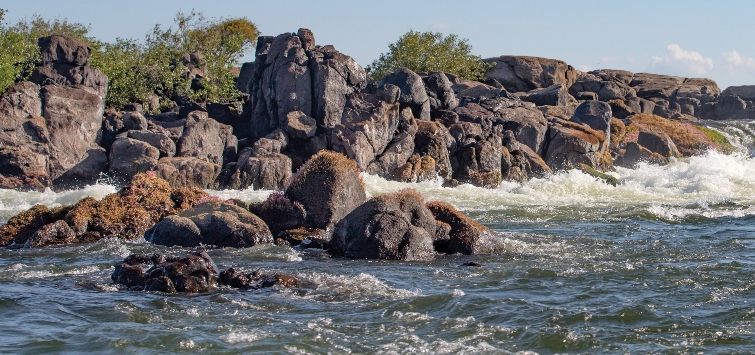
The blackwater here is as dark as the water in the Rio Negro, and it may even be darker than some parts I visited. The biggest difference, though, was the rock formations—and, oh my goodness, were there rocks! I was told that these mountains used to be under the ocean, and it’s not hard to imagine that based on their insane patterns and textures.
We hiked along the stream, but we didn’t see any fish. The water just became darker and darker, making it impossible to see under the surface. However, we did observe some really cool plants growing at the margin of the stream, including some sundews, a type of carnivorous plant.
The further we hiked into the mountain, the more rugged the terrain became. The rock bed that formed the stream looked to have been torn apart by a giant. What was a relatively smooth and flat surface became drastically jagged, with sharp chasms that suddenly dropped down to form multiple levels and sizes of waterfalls. The textures and shapes of the rock structures exposed by the gorges are absolutely incredible, perfect for inspiring beautiful aquascapes.
As the chasms got deeper and deeper, there were several bigger pools of water, as black as ink, circling around right after each fall. Due to the large amount of organic matter in the water, the strong surface agitation of the waterfalls creates a great deal of foam that floats atop the blackwater pools.
Following the winding trails and climbing down some very steep drops, we finally made it to the bottom of the deepest part of the gorge. From there, we’d have to get into the blackwater and swim to the waterfall. The temperature of the water is on the cooler side.
I would never have gotten in the water if it wasn’t for the other tourists swimming, as I couldn’t see my hands under the water surface. Who knows what monsters could be lurking in the depths?
We found more churned-up foam floating as we swam upstream, until, at the end of a narrow ravine, the space opened up and a huge waterfall revealed itself. It was a magnificent view. This blackwater waterfall is much taller than the one I saw in Colombia, which was only about 100 feet (30 meters) tall. The waterfall at the Big Hole, however, is about 260 feet (80 meters) tall.
The stone formations surrounding the waterfall were stacked into thousands of layers. Mosses of yellow and green grow on the side of the cliff, making it a feast for the eyes. We swam under the waterfall and did some small cliff diving, then headed back.
This wrapped up the first day of the expedition. Although I did not see a single fish, it had been beyond my expectations. The natural beauty and the dramatic landscape of this place was so inspiring, I couldn’t wait for the adventures that were to follow.
The Marimbus Pantanal
Our second day started bright and early. On the way to the main attraction of the day, we made a side trip to a historical site by the side of a cliff. It was a giant, unassuming boulder amidst the typical bushes of the Caatinga biome, but upon its surface was recorded the history of the people who once lived in this remote mountain range.
On the smooth face of the boulder, red markings clearly represented drawings of animals and other symbols. These paintings were from around 4,000 years ago. That these drawings still remain today adds to the sense of mystery and wonder of this region, and of South America as a whole.
Our main destination was a place called the Marimbus Pantanal, or the Pantanal of Bahia. The other, famous Pantanal region is the largest tropical wetland in the world, but Marimbus is much smaller. Formed by the Santo Antonio River and its tributaries, Marimbus is drastically different from its surrounding environment, and its unique eco-system is even recognized by UNESCO.
After just a short walk from the entrance of the park, we boarded a canoe at the edge of the water and started our exploration. Maybe because it was a weekday, or maybe it was just our good luck, but we were the only visitors during the entire time we were there.
Our guide paddled the canoe along a narrow channel, with land on one side and a “sea” of green aquatic plants densely covering much of the water surface on the other. The blackwater in this channel has a fast-flowing current, which didn’t make too much sense to me, since I had always considered wetlands to be more like stagnant flood plains. However, there’s definitely a uniform direction for the current, almost like a meandering river carving through a vast area of greenness.
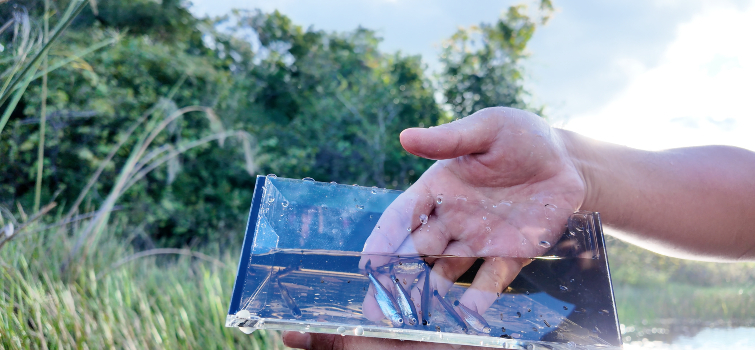
Right after setting off, we saw some bladderworts in the water. Juliana explained that these carnivorous plants use tiny traps to capture prey. We had no idea just how deep the water was, since it was so black. I brought my fish trap with me on this trip, so not too far from our starting point, I set it into the water and secured it to a dead tree sticking out of the surface. The plan was to leave the trap there with fish food inside, we’d come back in a few hours to see what got into the trap.
In hindsight, I realized I had set it in the wrong place. We were still in one of these smaller channels, where not only are there dense plants restricting access, but it’s also relatively shallow. Therefore, we ended up with only one species of small tetra, and meanwhile there are a number of large fish residing in this water body, like peacock bass, curimata, wolf fish, and gigantic catfish species. I regret not bringing fishing gear, as catching fish is the only way to observe them in this dark water.
We paddled for a short while before the channel opened up into a big clearing. I saw some commotion on the surface in the distance, which was definitely a sign of some sizable Chapada diamantina fish. Excited, I was ready to get into the water. The quietness of this place was extraordinary, with the water surface reflecting the beautiful blue sky. I found it a bit strange to not hear any sound from the animals or the water, but it was just so peaceful.
We stopped at a sandbank to climb off the canoe. The water here is very shallow, so we had slightly better visibility and easier access. Unfortunately, the exploration in this area would prove to be fruitless, with only some small tetras swimming among the plants. Juliana said the water can be much clearer depending on the time of the year, but visibility was quite low during our visit.
Day two of the expedition wrapped up with a slight sense of disappointment in encountering so few fish. However, the next day would see a dramatic turnaround, as we were to visit what I can confidently say is one of the best natural aquariums in the world.
The Blue Water Cave
Day three started with a banger. We woke up early so we could get to our destination and spend as much time there as possible. A lingering cold and the experience of the previous day left me with lowered expectations, but after a considerable amount of driving, we got to our destination: the Blue Water Cave.
The underground water had eroded away the limestone over the years, creating a natural sinkhole, much like the cenotes of Mexico. We were the first visitors of the day to enter the cave, and I was immediately mesmerized by how blue the water was. The water had a depth easily exceeding 6 meters, but it was so crystal clear that we could see every rock and pebble within the beam of our flashlight. Juliana told me there are cave shrimps and blind catfish here, so we eagerly put on our masks and fins and got into the slightly chilly water.
Snorkeling in the cave was spooky yet fascinating. On one hand, I imagined something dreadful watching and lurking just beyond the reach of my light. On the other hand, I was filled with a curiosity about what that something might be.
After a few minutes of exploring, awestruck by the rock formations, we spotted the first of many cave shrimps. They were entirely colorless and translucent, almost transparent, and quite similar to common ghost shrimp in appearance and size.
Once we saw the first one, we started to see them everywhere. They were foraging on what I can only describe as particles on the surfaces of rocks. Unfortunately, during nearly an hour of snorkeling, we didn’t see a single trace of a catfish.
Enjoying TFH Magazine? Subscribe Today!
A Crystal-Clear Spring
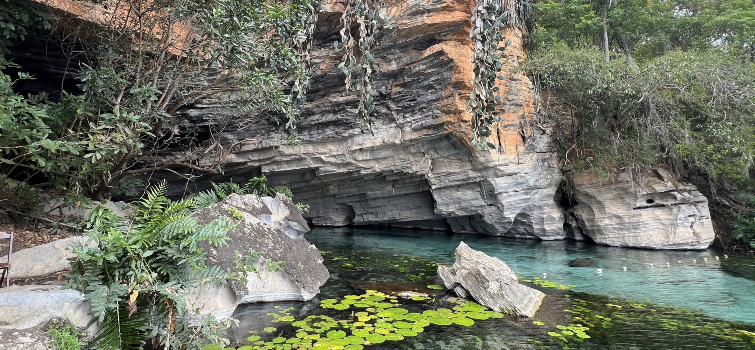
We got back in the car and headed toward the next spot, which was the main attraction of this area. Having had my spirits lifted by the cool cave snorkeling, my heart momentarily sank when we first arrived at our next destination. What Juliana described as a magical, crystal-clear natural aquarium looked like a nondescript pond encircled by a bit of woodland. It was probably about the size of a football field, with no special geologic features, such as rock formations or rapids; it looked no different than a man-made pond you’d see on a fish farm.
I could see some lilies growing in patches along the edge, and in the middle section, dense aquatic plants formed an area resembling a wetland. A small dock had been built to access the water, and a rope with buoys divided the pond in half, blocking us from entering the “wetland” area.
I was told that visitors were normally only allowed to access the area outside the roped-in section so they would not disturb the environment. However, since Juliana had been working with the management of this place to conduct research on its biodiversity, I was able to tag along with her and her husband, Daniel, over that line to explore the entire spring.
As soon as I got in the water, what seemed like a run-of-the-mill pond transformed into a magical underwater world right in front of my eyes. The “pond” is actually a spring with truly crystal-clear water with a beautiful blue hue. Although I’m not sure where the water flows out, we were able to identify the source of the spring using a drone.
The area before the rope was quite deep, with the deepest part being around 7 or 8 meters. This spring shares the same underground water as the Blue Water Cave we visited in the morning, but here Chapada Diamantina fish were schooling in incredible numbers.
I immediately saw large schools of tetras hanging out by the dock—there must have been tens of thousands of them, maybe more. Their shiny scales glistened under the piercing sunrays. I couldn’t identify all of the tetra species, but there were definitely Moenkhausia species, with M. costae being one of the easiest to identify.
The next phase of our expedition revealed what I would arguably say was the most beautiful natural aquarium in the world. Despite its unassuming appearance above water, diving into the clear-water springs of Chapada Diamantina, I soon found what was waiting for me beneath the surface was truly awe-inspiring.
Aside from the countless tetras that schooled right in front of me, I soon spotted some cichlids hanging out around the rocks on the bottom. The front half of this pond, where it’s accessible to the general public, is much deeper, up to 5 to 8 meters. There are sparse patches of weedy plants covering the bottom and some small swordplants near the shallow margin, but the substrate is mostly covered by fine debris and large rocks.
With the water so clear, we could see some small eartheater-type cichlids guarding their home at the deepest part. Right away, we saw the same fish at the shallower bank of the pond, surely a species of Geophagus. Later, we found out they were Geophagus diamantinensis, a newly described species.
The mom, at about just under 4 inches (10 cm) or so, was guarding her fry among the rocks. Her body was almost entirely yellow, with black stripes and markings, which I’m pretty sure is a breeding color, similar to some of the Apistogramma species. She didn’t shy away from our cameras, instead fiercely defending her fry.
We said goodbye to the mother and her babies and moved on to explore other spots. I swam across to the side with all the lily pads to check out what fish were hiding there. On the way, I saw turtles breathing air on the surface, but as soon as they saw me, they dove down to walk along the bottom.
An Unexpected Oscar Encounter
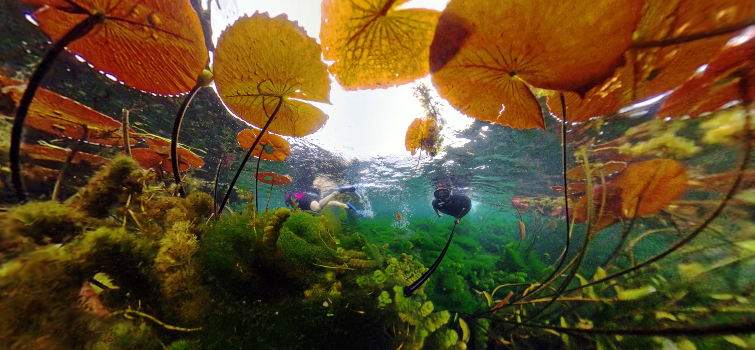
As I got closer to the margin, the water became much shallower. More plants, such as swordplants, lily pads, and lotuses, began to appear. I swam by a few lily pads about the size of my head, some with a beautiful red-orange color on top and purple on the bottom of the pads.
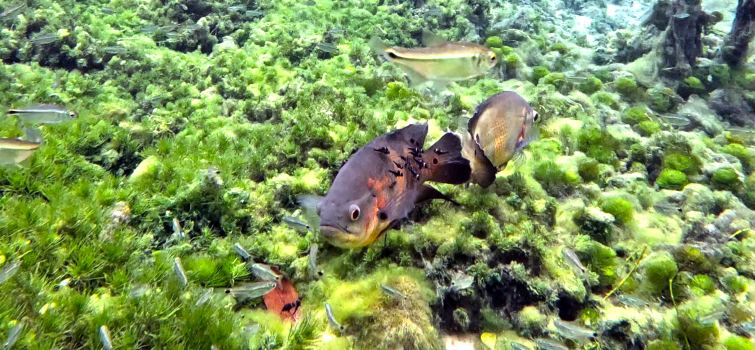
I didn’t observe a lot of flow in the water, so the lily pads were just floating on the surface very peacefully. Just as I moved closer to a dense patch of lilies, I saw two large, dark round shapes in the midst of all the greenery. Before I could focus my eyes and identify what I was looking at, they suddenly dashed out! It was a pair of large oscars, with at least 50 smaller ones behind them.
I had not thought I would see oscars in this water, so it took me completely by surprise; they almost certainly had been introduced into these waters. I knew Juliana would be excited to hear about this, but, as eager as I was to tell her, I had to seize the opportunity and observe the group for as long as I could.
I followed them through the water. The juveniles had a wildly different pattern from the adults, with jet-black bodies covered in small white dots. They were roughly 3 inches (7.5 cm) in length and moved together in a tight, coordinated group, staying close to the adults. I tried my best to bring the camera closer for a better view, but the adults suddenly dashed into a dense patch of lily pads and soon disappeared. We don’t normally observe oscars behaving this way in captivity, and seeing the loose family group moving together in the wild was a remarkable experience.
I was so hyped at this point and eager to share what I had seen with Juliana. I swam back to the dock right away. Juliana said she had been at the lily patch for more than 30 minutes but hadn’t seen any oscars, so she went over to investigate.
This gave me time to set up my fish trap with Daniel. I wanted to see what kind of bigger fish we could catch, so I set the trap at the deepest point of the pond. After I finished, Juliana had also made her way back to the dock. She was telling me that I really had to go with her to see the area beyond the line, so we got back into the water.
Into the Shallows
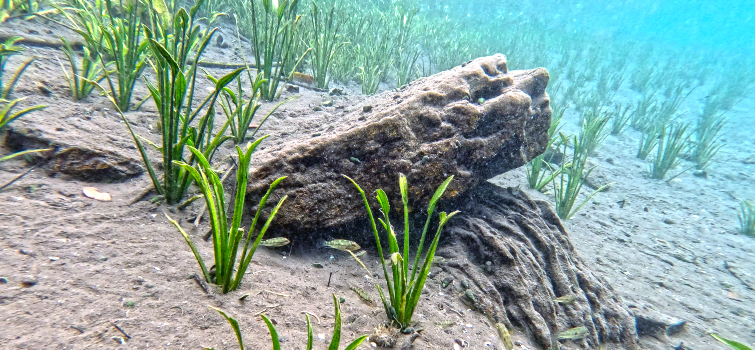
The bottom of the pond rose steeply right after we crossed the line and became very shallow. In these areas, the plants grew much more densely. In the shallowest areas, thick swordplant growth abruptly gave way to a dense patch of bladderworts (Utricularia sp.) with tiny white flowers.
Although the water was very shallow at this point, we were still able to swim forward. With a blue-turquoise backdrop, tiny white flowers adorned a carpet of greenery, providing a rippling reflection on the water surface, and schools of tetras surrounded us in every direction.
When we came to the middle of the pond, the water was so shallow that some parts had barely any depth. This area was almost like a wetland where plants grow so densely that we had no choice but to get out of the water and step over them to cross.
The majority of plants were swordplants with strong stems that sent their leaves above the water surface. Amid these dense leaves, we could see schools of small tetras swimming. There were patches of open areas among the plants where they can’t grow because of the large pieces of stones on the bottom. In these open areas, a few lilies grew, and there were colonies of eartheaters that had claimed this area as their home.
The color palette was just incredible! The lilies had a mixture of an entire spectrum of reds and oranges, while the surrounding plants had a range of yellowish green to dark green. Together with the turquoise water, it looked like an oil painting. Even the stones had this yellowish orange hue, with complex textures that added an additional layer of beauty to the scene.
This dense patch of plants that we had to cross was about 8 to 10 feet (about 3 meters) wide. After that, the water gradually became deeper again. Once we got over a little hill of densely grown water weeds, the water cleared up and became about a meter deep, but this entire half of the pond didn’t get deeper than 1.5 meters at any point. As we got back into the water again, the sun shone directly above, which sent a million sun rays piercing through the rippling water surface. I felt like I had entered a paradise.
A Field of Water Lilies
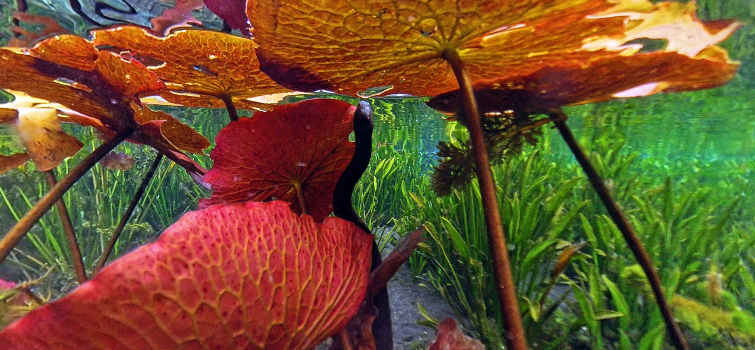
Following Juliana’s lead, we swam forward and started seeing more and more lilies. They were as tall as the water was deep, with some newly grown pads on the bottom and others floating on the water surface. The light penetrates these surface lily pads, making them glow red.
On the bottom, a thick layer of algae with fresh green color formed a carpet of fuzzy cushions. Calling it just “algae” sounds wrong somehow, since we think so negatively about algae in the aquascaping hobby, and this algae transformed this natural aquascape into a completely different world!
The round cushion-shaped algae formed rolling hills that went up and down, up and down, endlessly. Lilies grew out of them like giant trees in a rainforest but with a red umbrella-like canopy. Some parts of this lush “rainforest” had a bush of water weeds towering out of the algae, while some parts of the bush had algae growing upward with it, continuing to make me feel like I was on another planet.
The Meeting of Two Waters
A bird’s eye view of a beautiful and rare natural phenomenon at the end of the spring-fed river the group explored. The clear river flows out from a cliffside cave and ends here, where its crystal-clear water collides and mixes with a blackwater river.
We came to a dense patch of lilies that seemed like the wall of a secret garden and swam along it until there was a break that formed an “entrance.” Entering the garden, I almost gasped behind my diving mask. I will try my best to describe the sight with words, but I doubt I can do it any justice. Imagine tens of thousands of tetras schooling in endless streams in different directions as they traveled through the lilies and other plants above a beautiful forest of green. With the crystal-clear water, it eclipsed the most beautiful natural aquariums I had ever seen in my life.
The “garden” was so beautiful that I didn’t want to leave. However, I was deeply curious to see what other amazing sights awaited us, so we swam out and headed to another part of this unbelievable place.
Swimming with Cichlids
I arrived at a small clearing and immediately saw a group of six juvenile peacock bass huddled together in the near distance, a regrettably introduced species in this paradise. They were about a foot (about 30 cm) in length, already colorful with red orange fins, yellowish green base color, many small gold spots, and several distinct black spots all over their body.
I was so pleasantly surprised by the sight of them that filming them up close was all I could think about. The peacock bass were very cautious. As soon as I got too close, they swam away. Trying to keep up with these fast predators wasn’t easy. I had to kick my flippers as hard as I could to give a good chase. Since they were quite large already, they only swam in the open water space, so I was able to follow them for a good five minutes before they finally got tired of me and disappeared into the dense lily patches.
I was so ecstatic from swimming with peacock bass in the wild (and the intense cardio workout it involved) that I felt a bit dizzy. I haven’t learned to snorkel over a long period of time, so I get motion sickness very easily. Therefore, as much as I wanted to keep on exploring, I knew I had to head back to the dock for a break.
On my way back, though, I spotted a colony of Geophagus hanging out at the shallow patch of plants. I crawled on all fours and put my head under the water. Carefully positioning my camera so I didn’t spook them, I inched closer to get a better look.
The Water Snake and the Wolf Fish
This is when, in the corner of my eye, I noticed a brown branch-looking thing moving. Its motion was a particular slithering, and I knew immediately that I had found a water snake. For some reason, I’m always the water snake spotter within the group. But this was beyond my expectations, and I couldn’t believe my good luck.
I sneaked my camera closer to it, but the snake didn’t seem to mind. It was a smaller specimen, less than 4 feet (120 cm) long, with its body about as big around as my thumb. Its whole body was dark brown, with some black spots spread around. I had a hard time keeping track of its position as it slithered very quickly and gracefully among the plants.
Just as I thought I had lost track of it, I found the snake coiled up at the bottom of a big lily. It raised its head along the stems, rising all the way to the water surface to breathe.
What an incredible sight! My face had been just over a foot away from this beautiful creature, and I had my camera positioned even closer. The little snake ignored me and took a long breath right next to the lily pad, perfectly keeping itself out of sight from aerial predators.
The snake breathed for two to three minutes before it retreated back down and slithered away. It was difficult moving around this shallow patch, so I couldn’t follow it any more than that.
It was enough time to check on the fish trap, where we discovered that we had caught a young Hoplias wolf fish. It was about 6 to 8 inches (15 to 20 cm) in length. We brought it out of the trap and took a good look at its impressive teeth before setting it free.
More Journeys to Come
That concluded the most unbelievable day of the entire expedition. I simply couldn’t imagine how the next spots were going to be more breathtaking than that. The next day, we went into the mountains in search of the elusive Hasemania negodagua, a silvery tetra with white tips on its fins that was, until recently, better known as a Hyphessobrycon species. Unfortunately, we did not have any luck finding them.
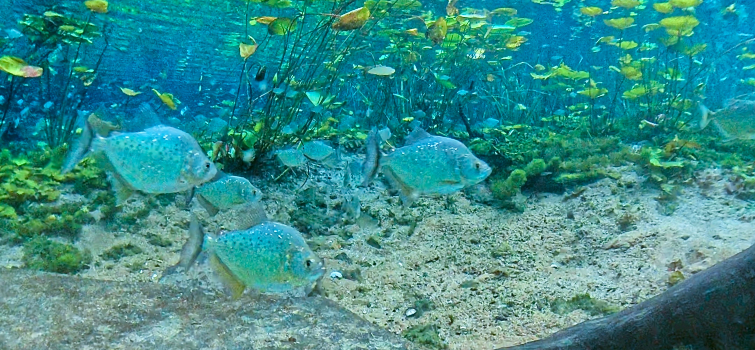
We spent the final two days at another spring-fed river, where the water came out from a cave similar to the Blue Water Cave. In this crystal-clear spring, we saw many more species of Chapada diamantina fish including piranhas, plecos, and even some invasive species, like tilapias.
That was also an amazing place, but I’ll save that story for another time.
The author would like to thank Juliana Leroy and Daniel Gomes for their invaluable contributions to this article series. Be sure to check out Juliana (@caminhosdesconhecidos) and Mark (@tmk_aquarist) on Instagram.