
![]()
Marine Invert of the Month
Bob Goemans
September 2010

Mithraculus (Mithrax) sculptus
(LAMARCK 1818)
N/A
Common Names: Emerald crab, green clinging crab, jade crab, mithrax crab, hardback crab, green crab
Phylum: Arthropoda
Class: Malacostraca
Subclass: N/A
Order: Decapoda
Family: Mithracidae
Range: Tropical western Atlantic Ocean: Florida Keys and the Caribbean
Natural Environment: This large-bodied species, with sizeable forearms and claws, is usually found living on algae-covered rocky coastlines, backwater areas with algae-covered rock surfaces and rubble, and in seagrass beds.
Captive Care:
These heavily armored crabs have a shiny-green carapace and claws, with hairy, dark-green walking legs. Their claws have blunt tips used for feeding on different forms of algae, including bubble algae Valonia. Though this crab is often sold as an herbivore, it is actually omnivorous, and while thought to be reef safe, larger specimens—i.e., about 3 to 4 inches in diameter (from leg tip to opposite leg tip)—may turn into predatory creatures and eat small fish and possibly other small animals in the aquarium. In fact, anything with a claw that does not have its fill of its normal foods found in the wild will turn toward other sources of food, tasty or not! Therefore, this is not a totally reef-safe animal, and even if kept in a fish-only aquarium, thought should be given to what size and type of fishes are maintained in that system.
As for feeding, they are not fussy eaters, as small members will scavenge various forms of algae, but more mature ones may turn to other foods if they do not have an adequate supply of algae. Therefore, in systems somewhat devoid of algae, plant rocks—e.g., those covered with different forms of algae (micro or macro)—may be a way of satisfying their nutritional needs, thereby preventing them from turning to other forms of food for nourishment.
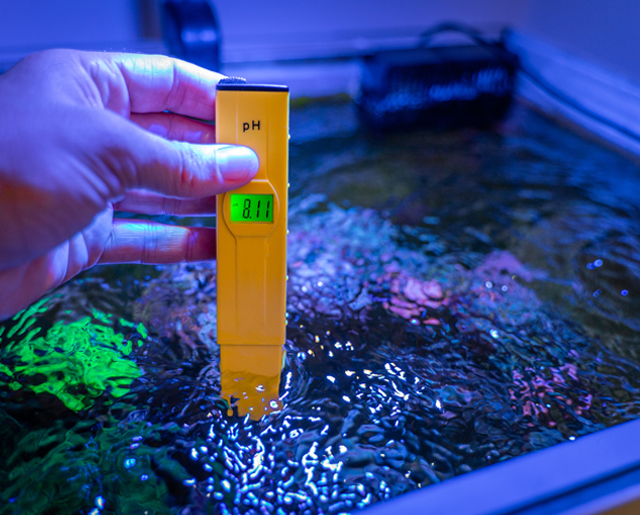
Water Quality Requirements: Calcium 380 to 430 ppm, alkalinity 2.5 meq/l, pH 8.1 to 8.2, specific gravity 1.024 to 1.026, and a temperature range of 75° to 82°F.
Notes: How to catch unwanted crabs is a question I’ve fielded numerous times. Besides the baited trap that drops a door sealing off an escape route, the least expensive way I’ve found to rid some unwanted specimens comes with the use of a large, tall drinking glass. Simply place a tasty morsel at the bottom of the glass and place it at the aquarium bottom against some rock in the late evening. The crab will sense the food at some time in the evening or early morning hours, and it will use the rock surface to gain entrance to the lip of the glass. Once it falls to the bottom of the glass, it won’t be able to climb out. This is not always 100-percent effective, as some crabs are fairly good swimmers, but this method has resolved some terrible crab problems in some aquariums.