
Skip to content

resources

Marine Invert of the Month
Bob Goemans

August 2009

Marine Invert 0907

Protoreaster nodosus

Bob Goemans

(Linnaeus, 1758)

Common Names: Chocolate chip sea star

Phylum: Echinodermata

Class: Asteroidea

Subclass: n/a

Order: Valvatida

Family: Oreasteridae

Range: Indo-Pacific Ocean to Eastern Africa

Natural Environment: This species is usually found on shallow sandy and muddy bottoms, and seagrass beds in lagoon and back reef areas where it is thought to feed upon sponges and other benthic invertebrates.

Captive Care: This sea star is not suited for reef aquariums, as I’ve heard of it devouring anemones, gorgonians, soft corals, sponges, clams, urchins, tubeworms, and small sleeping fish.

It is a commonly collected species, simply because it’s plentiful and easy to catch in the wild. Because of its physical shape, i.e., wide arms and thick spiny body, it is incapable of searching for food between rockwork in most aquaria. In captivity, therefore, it requires a more open environment that is easily navigated, such as what may be found in many fish-only aquariums.

And since its central disc area can attain a diameter of about 5 inches (12.5 cm), I would consider a 100-gallon aquarium the smallest in which it should be kept.

Keep in mind these creatures are toothless and either swallow their prey whole, then expel the undigested parts (such as hard shells), or they extend their stomach and digest whatever they are resting upon, such as what the crown-of-thorns does to coral polyps.

As for feeding, there probably isn’t a hobbyist aquarium that can naturally provide this creature its necessary nutritional needs long term. I suggest placing different types and sizes of organic foodstuffs on the aquarium substrate just prior to the lights going out. These creatures, if healthy, are very capable of knowing when food enters the aquarium and will quickly take the shortest path to the foodstuff. Long-term success rate with this sea star appears to be poor, as most die of malnutrition. And keep in mind, all sea stars/starfish are very vulnerable to sudden salinity changes. Therefore, acclimate carefully before transferring new purchases to your aquarium.

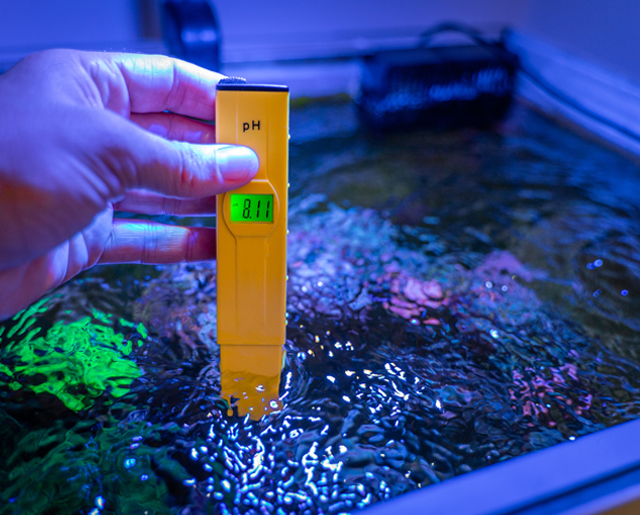
Water Quality Requirements: Calcium 380 to 430 ppm, alkalinity 3.5 meq/l, pH 8.1 to 8.2, specific gravity 1.022 to 1.026, and a temperature range of 72° to 81°F (22° to 27°C).

Notes: The phylum Echinodermata includes urchins, brittle stars, starfish, cucumbers, and feather stars. The word “starfish” is a misnomer, as they are of course invertebrates, not fish. However, their star-shaped body lends certain realism to the term. Generally, most are found in shallow coastal areas, though some are found at depths reaching 20,000 feet! They have an internal calcium skeleton and travel using tube feet. Their vascular system pumps water, not blood. By pumping water into or out of their tube feet, the animal is capable of securing itself to most surfaces. Except for cucumbers, their mouth area of the echinoderms usually contacts the substrate. And except for cucumbers, they have no anus; food and waste exit the same opening. When it comes to starfish in general, only a few are truly suited for the aquarium, with the majority—now more properly referred to as “sea stars”—being either carnivorous or omnivorous. They can eat small fishes, algae, mollusks, detritus, and coral polyps.