
.png?h=595&iar=0&w=2781&hash=5FD5E69473BCC22199FBFA2FB71B6033)

Journey to the Mighty Rajang River of Sarawak
Author: Lo Shiang Huei (Michael Lo)
Our author takes you on a trip to the waters of Malaysia, home to a variety of aquatic treasures. The blackwater streams may not always be a pleasure to wade through, but the exotic fish and plant life certainly make it worthwhile!
To the Batang
The Batang Rajang (or Rajang River) is the longest river in Malaysia. The aquatic flora and fauna in this mighty river are among the most diverse in my country—every time I come to visit this river basin, I find a lot of beautiful fishes and aquatic plants in different places that I had not explored before.
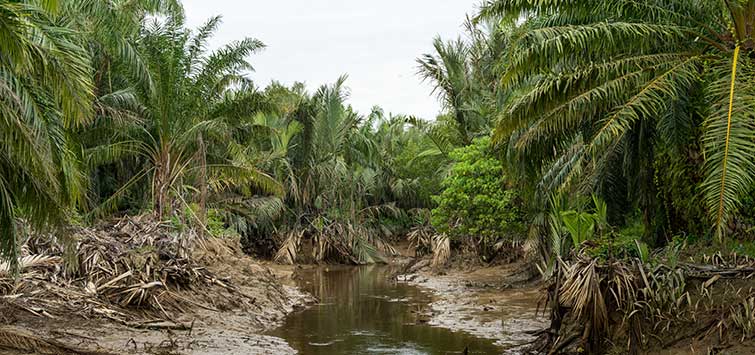
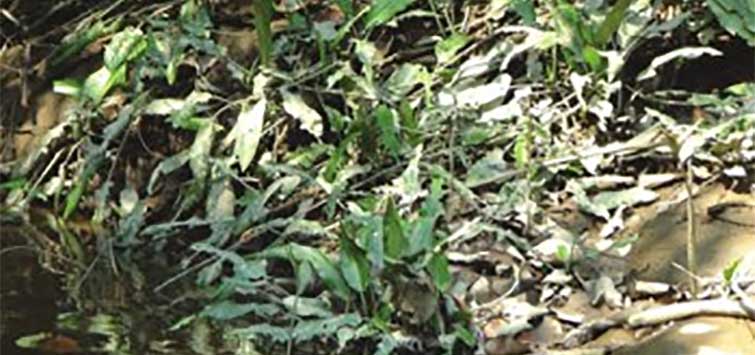
At the end of the rainy season, my friend John and I decided to drive to the town of Sibu, from Kuching, to collect Cryptocoryne for our aquariums. The drive lasted six hours before we reached the first collecting spot, a blackwater river mixed with brackish water near Sibu. We walked past the muddy trail to a shaded area near the river, where a clump of Cryptocoryne lingua was growing lavishly. This species prefers to grow in either a freshwater or brackish area with tidal influence, where the main substrate consists of silt.
Looking for Cryptocoryne
After collecting C. lingua, we drove to a nearby peat swamp for another species of Cryptocoryne. In this location, an acidic blackwater stream flows past an old rubber plantation. C. pallidinervia grows abundantly in this stream in either open or shady areas. When I stood closely to the Cryptocoryne in the stream, I saw a school of tiny fish swim past my legs—they happened to be one of the smallest fishes in the world, Paedocypris micromegethes. This tiny little fish is always overlooked by people; the length of its body is typically less than 1.2 cm (less than ½ inch). The species is also very fragile—I learned that if it is exposed to the air for even a few seconds, it won’t survive for long.
Besides Paedocypris micromegethes, we also caught Parosphromenus allani, Betta akarensis, Rasbora kottelati, and some other blackwater fishes common to the Sibu area.
On to Sibu
After packing the fish and plants into our car, we headed north to Sibu. Before crossing over the Rajang River on the Lanang Bridge, we turned to a small country road to explore the area. When we reached a canal, we were stunned by a view that neither of us had seen before in our lifetime! It was here that we witnessed thousands of Cryptocoryne lingua growing along the canal and the nearby rivers out in the open, covered by a layer of mud. Unfortunately, all of them disappeared into the water when the tide came in a few hours later.
Stunning Plants Along the Rajang
The next day, we drove west along the Rajang River to collect Cryptocoryne yujii from another blackwater river. Before reaching our destination, we spotted a beautiful swamp orchid Papilionanthe hookeriana, which grows abundantly in the swampy area.
At the next location, we saw three species of aquatic plants growing in this acidic river. There were dark-reddish colored Barclaya mottleyi, light-green colored Cryptocoryne yujii, and the hair grass Eleocharis sp. The substrate is very soft and acidic peat soil. We could not walk into the middle of the river, as the soil was too soft, so we only managed to collect some plants from the riverbank.
All of the water plants we collected were wrapped up using wet newspaper and then kept inside a plastic container in order to maintain moisture; this would effectively prevent the leaves from drying up.
Julau
After crossing the Rajang River using the new Durin Bridge, we headed east to the town of Julau. We stopped our car near a clearwater river that rested beside a native’s longhouse. There were no water plants near the bridge, so we walked along the river to a shaded area covered by forest. We found some dark-purple and greenish colored Cryptocoryne striolata growing on the submerged rocks. This Cryptocoryne species happens to be the most common aquatic aroid in Borneo.
We later visited another two locations to collect Cryptocoryne auriculata and C. bullosa. Both species are also found in clear and slower-flowing streams. After collecting and packing all of the plants into our container, we left Julau exhausted and began the long journey back home.
The population of Cryptocoryne in the lower part of the Rajang River Basin is considered one of the largest in Borneo. However, a lot of the habitats of Cryptocoryne have been destroyed due to logging, water pollution, farming, and construction. It is sad to see this natural wealth decimated.
References
Tan, H. H., and P. K. L. Ng. 2004. “Two New Species of Freshwater Fish (Teleostei: Balitoridae, Osphronemidae) from Southern Sarawak, Sarawak Bau Limestone Biodiversity.” (eds. H. S. Yong, F. S. P. Ng and E. E. L. Yen). The Sarawak Museum Journal. LIX, 80(6):267–284.
Jongkar, G., and K. K. P. Lim. 2004. “Fishes, Sarawak Bau Limestone Biodiversity.” (eds. H.S. Yong, F. S. P. Ng and E. E. L. Yen). The Sarawak Museum Journal LIX, 80(6):285–298.
Brown, A. and B. Brown. 1987. “A Survey of Freshwater Fishes of the Family Belontiidae in Sarawak.” The Sarawak Museum Journal XXXVII, 58:155–170.
Inger, R. F., and Chin P. K. 2002. The Freshwater Fishes of North Borneo. Natural History Publications, Borneo.
Kottelat, M., A. J. Whitten, S. N. Kartikasari, and S. Wirjoatmodjo. 1993. Freshwater Fishes of Western Indonesia and Sulawesi: Periplus Editions, Jakarta. XXXVIII, 221 pp., including “Additions and Corrections.” 1996. M. Kottelat & A. J. Whitten. 8 pp.
Tan, H. H., and P. K. L. Ng. 2005. “The Fighting Fishes (Teleostei: Osphronemidae: genus Betta) of Singapore, Malaysia and Brunei, Southeast Asian Freshwater Fish Diversity.” (eds. M. Kottelat and D. C. J. Yeo). The Raffles Bulletin of Zoology. Supplement No.13:43–99.
Tan, H. H., and Peter K. L. Ng. 2005. “The Labyrinth Fishes (Teleostei: Anabantoidei, Channoidei) of Sumatra, Indonesia, Southeast Asian Freshwater Fish Diversity.” (eds. M. Kottelat and D. C. J. Yeo). The Raffles Bulletin of Zoology. Supplement No.13:115–138.
Parenti, L. R., and K. K. P. Lim. 2005. “Fishes of the Rajang Basin, Sarawak, Malaysia, Southeast Asian Freshwater Fish Diversity.” (eds. M. Kottelat and D. C. J. Yeo). The Raffles Bulletin of Zoology 2005. Supplement No.13: 175–208.
Bastmeijer, J. D. 2006. “Cryptocoryne.” The Crypts Pages. http://www.nationaalherbarium.nl/Cryptocoryne/index.html
Ipor, I. B., C. S. Tawan, and N. Jacobsen, 2005. “A new species of Cryptocoryne (Araceae) from Borneo.” Gardens’ Bulletin. Singapore. 57:1–6.
Kottelat, M., R. Britz, H. H. Tan, K. E. Witte. 2006. “Paedocypris, a new genus of Southeast Asian cyprinid fish with a remarkable sexual dimorphism, comprises the world’s smallest vertebrate.” Proceedings of the Royal Society B:1–5.
See the full article on TFH Digital http://www.tfhdigital.com/tfh/200809/#pg83