
Cichlids of the Ornamental Fish & Aquarium Show in Duisburg, Germany
Author: Iggy TavaresSurround yourself with cichlids of all shapes and sizes! The author pays a visit to one of the largest fish shows held in Germany, where thousands of cichlids are put on display in some of the largest tanks seen yet.
The 10th Zierfische & Aquarium (Ornamental Fish and Aquarium Show) was held in
Getting to
The
The hall at
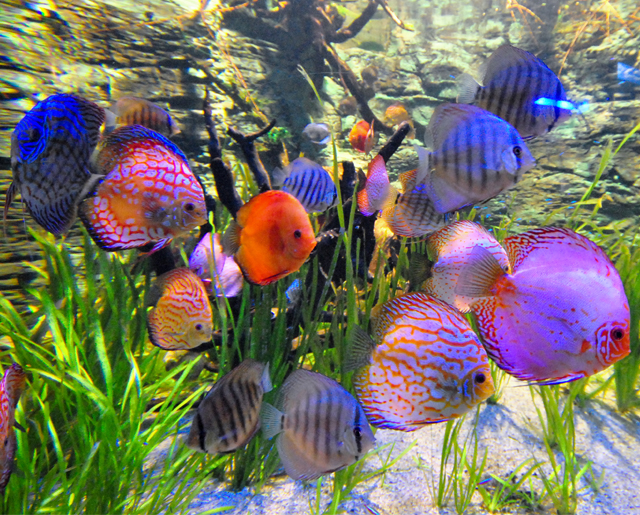
There were also numerous traders selling fish—particularly cichlids—all of which had some beautifully furnished aquariums on display in addition to their fish for sale. Hobby-Zoo-Duisburg had a good selection of large cichlids such as Amphilophus citrinellus, Parachromis friedrichsthalii, Vieja maculicauda, and V. synspila. They kindly allowed me to photograph these, and even provided a ladder for me so I could reach the upper tiers. Other cichlids available at the show ranged from a good selection of African Rift Valley cichlids to South American dwarf cichlids, as well as a good selection of discus. There were at least three outlets selling marine fish, all of them with beautiful fish and reef display tanks, but I did not get around to checking them out in the end. There was also a good selection of dwarf catfish and colorful dwarf shrimp, as well as a comprehensive selection of plants available at various retailers.
The
Halfway down the hall, I came across the giant 23,000-liter (6000-gallon) cichlid tank, measuring around 7 meters (23 feet) long, 2 meters (6½ feet) tall, and over 1½ meters (5 feet) wide. The tank was filled with cichlids of Lakes Malawi and
Larger fish such as Protomelas spilonotus, Aristochromis christyi, Cyrtocara moorii, and others were provided by Andreas Spreinat. This giant aquarium, overcrowded to reflect the wild habitat, was buzzing with fish activity that included male cichlids trying to attract females to their spawning sites (actually spawning on occasion) while a large black tilapia Oreochromis mossambicus enjoyed posing at the large central window. I did unfortunately miss a highlight at this aquarium, where Spreinat would swim in the tank at specified times to feed the fish. On the Monday after the show, 80 percent of the water was drained from the huge tank before the plants and rocks were removed, and finally the cichlids were then captured with nets, after which the whole tank could then be stripped down.
The DCG Cichlid Display
African Cichlids
I finally made my way to the cichlid show tanks that the German cichlid society had organized, which were at the back of the hall in 400 square meters (4300 square feet) of space. These new tanks were all provided by Zoo Zajac, but they were decorated and furnished by individual cichlid hobbyists. With more than 50 tanks to observe and photograph, I was certainly in for a treat. What better way to start than to find that the first tank contained a pair of bright red jewel cichlids that were looking after tiny fry! At this show, African cichlids appeared to be in the ascendancy, with three tanks carrying individual Lake Victoria cichlid species or variants: Pundamilia igneopinnis, P. nyererei “
Among the many tanks with Lake Malawi cichlids was a crowded Mbuna display with 30 each of Pseudotropheus estherae “red zebra,” Pseudotropheus saulosi, and Melanochromis sp. “maingano.” The tank was an eye-catcher due to the color and action. There was another tank of
There were also several tanks containing the smaller Tanganyikan cichlids. One setup made good use of the space inside the tank, where dozens of colorful, orange-yellow Neolamprologus leleupi contrasted nicely with the dark-colored Julidochromis transcriptus, both of which are substrate and rock huggers, while the upper waters had Altolamprologus compressiceps. Another tank had the bottom-sitting Xenotilapia caudafasciata and X. ochrogenys alongside the shell-dwelling Lamprologus ocellatus. It also featured normal-colored and albino forms of Cyprichromis sp. “jumbo Kitumba.” One display that caught my eye was a tank filled with Cunningtonia longiventralis “Kachese,” where a few sky-blue dominant males vied for the attention of females while building and defending their nesting sites, consisting of mounds of sand.
American Cichlids
The South American front was well represented by a large school of wild brown discus in a dimly lit, well-planted tank decorated with plenty of bogwood, while colorful domesticated discus occupied another large tank. An interesting display of Pterophyllum altum angels were set up in a tank containing a maze of upright bamboo poles for the angels to swim through. An attractive South American display with plenty of bogwood contained a very large group of Satanoperca sp. “Letitia” that were rather nervous for a couple of days, but eventually settled down as the show went on. This tank was also home to a huge shoal of Gasteropelecus sternicla (rather flighty hatchets) a large Panaque, and interesting-looking Loricaria sp.; the latter two were both wild caught from Rio Pauto in
A large Central American tank contained large specimens of three Thorichthys species, with wild-caught T. meeki, T. aureus, and T. ellioti. On the first day, two male firemouths were putting on a colorful display, flaring their bright red gills and throats. By the next day, one had paired up with a smaller female and was searching for a spawning site among the large rocks in the middle of the aquariums. Meanwhile, the large T. ellioti pair was the first to spawn on the large vertical side of a rock situated near the right-hand side of the aquarium. The female not only fanned the tan-colored eggs, but also defended their patch from all of the other cichlids. These actions drew a lot of interest from the visiting crowd.
Dwarf Cichlids
Dwarf cichlids from South America and
Lectures and More
There was a comprehensive range of informative and interesting lectures in German held daily and delivered by well-known fish experts such as Andreas Spreinat, Heinz Büscher, Heiko Bleher, and other individuals. Some lectures covered the care of specific cichlids and included advice on optimum water values, health care, and breeding. Other lectures covered the collection of cichlids from their wild habitats, giving hobbyists a chance to dive into the lakes and rivers via the speakers’ colorful slides. The experts were happy to take questions after the talks and gave valuable advice, including some tricks of the trade used to bring about spawning.
The DCG ran a photographic competition inviting entries prior to the
Another highlight of going to
Conclusion
The Ornamental Fish and Aquarium Show in
What made the Ornamental Fish and Aquarium Show in
See the full article on TFH Digital http://www.tfhdigital.com/tfh/200808/#pg116